This is a webpage version of a report from Living Streets, which is also published as a pdf document. This version has been adapted to focus on providing accessibility for people who want to enlarge the text or to use a screen reader
This literature review has been produced as part of the Living Streets project ‘Inclusive Design at Bus Stops and Continuous Footways’. This project is funded by the Scottish Road Research Board (Transport Scotland) and Department for Transport.
The key information below is taken from the document cover pages:
Document title: Inclusive Design at continuous footways, Literature review
Document date & version: October 2023, Version 11.1.2
Publishing organisation: Living Streets
Author/research lead: Robert Weetman
Annex A author: Rachel Lee
Editing/reviewing: Emma Pearce (Living Streets), David Spaven (External editorial support), Alisha Pathania & Emma Koprena (Transport for All)
We are Living Streets, the UK charity for everyday walking.
We want to create a nation where walking is the natural choice for everyday, local journeys; free from congested roads and pollution, reducing the risk of preventable illnesses and social isolation. We want to achieve a better walking environment and to inspire people of all generations to enjoy the benefits the simple act of walking brings.
By ‘walking’, we include ’wheeling’.
The phrase ‘continuous footway’ is used by many to describe a situation where the footway (pavement), which runs alongside the edge of a carriageway, continues unbroken across the end of a side road or private entrance.
This literature review was produced as an early stage in a two-year research project, titled ‘Inclusive Design at Bus Stops and Continuous Footways’, during which Living Streets is investigating issues around inclusion both at continuous footways and where cycle tracks are provided at bus stops. This will help to frame the scope of the larger project, establishing key issues, current knowledge, and gaps in knowledge.
In producing this review we studied formal infrastructure guidance on continuous footways, informal literature, research, and policy documents. We concentrated on UK-focused literature but, because it has been suggested that UK designs are inspired by those in the Netherlands and Denmark, we also looked at key Dutch and Danish documents.
We looked for evidence on whether terminology is used consistently, and whether guidance is consistent on how continuous footways should be designed. We looked for the reasons given for the introduction of continuous footways. We compared British traffic rules with those in Denmark and the Netherlands, considering whether differences need to be taken into account in copying foreign designs.
We confirmed that there is significant inconsistency in terminology, and that design guidance differs on key details. We confirmed that the situation in the UK is complex in regard to rules and legislation which might affect the provision of continuous footways. We contrast this with the clear and consistent situation described in Dutch guidance and in wider Dutch literature.
We confirmed that there is agreement in UK literature that continuous footways can be used to prioritise the movement of either pedestrians, or of cyclists (if combined with a cycle track), but that many documents only suggest benefits for one of these groups, omitting mention of the other.
We looked for research on the design, functioning, and safety of continuous footways. There appears to be little published research, even in Dutch literature.
We found two key UK-focused research reports on designs which are described as providing continuous footway. These highlight a situation where behaviour varied greatly across different sites, where some sites show improved behaviours, but where a significant portion of drivers do not give way to pedestrians. However, we note that there are suggestions in the research, and in wider literature, that none of the designs studied to date may be of the standard that is required to ensure safety, and to achieve the intended effects.
The little Dutch research we could locate, describing their ‘exit constructions’ (which create a continuous footway), suggested that consistency in design and compliance with Dutch guidance was important if these were to be as safe as junctions with a marked priority.
Dutch research also suggested that the use of exit constructions could best be justified not as a local measure to improve safety at individual junctions but as part of the more significant area-wide changes resulting from their ‘sustainable safety’ policy. It was clear that exit constructions are seen as having a very well-defined role within the wider design framework mandated through this programme (which is a national ‘systemic safety’ programme). These wider purposes focus on its effect in producing a ‘gateway’ to clearly mark the transition between a road carrying traffic through an area and an area of local access streets designed to create slow speeds, and to discourage through traffic (adding to the effect produced by streets belonging to one category being designed to be distinct from those in the other category).
In formal UK literature we found little mention of any vision that continuous footways should be used for similar effect, nor of how their introduction might be part of any wider design framework.
The wider ‘Inclusive Design at Bus Stops and Continuous Footways’ project is investigating whether continuous footways can be delivered in a way that improves the inclusivity of our streets. Therefore we looked for written accounts of opinions on this, and for supporting evidence. We found anecdotal evidence, rather than systematic studies, which suggest that there may be particular issues for blind and partially sighted people. Although there was some limited design guidance on tactile paving this guidance was inconsistent and contradictory.
In this regard we make two tentative observations, which we intend to test as part of the wider Living Streets project. Firstly, we suggest that it is difficult to defend a design which fails to establish a very high degree of priority for pedestrians, yet which also fails to warn pedestrians who are blind or partially sighted that they are walking onto such a design. Secondly, we suggest that that where such designs are used they also need features which physically and significantly constrain speeds.
An infrastructure design known by many as ‘continuous footway’ continues the footway (pavement) beside a carriageway across the end of a side road or private entrance.
This literature review has been produced as an early stage in our two-year research project ‘Inclusive Design at Bus Stops and Continuous Footways’. This is funded by Transport Scotland and the Department for Transport, allowing us to investigate problems of inclusion at both continuous footways and where cycle tracks are provided at bus stops. This literature review focuses on continuous footways, while a second literature review – produced in parallel – concentrates on bus stops.
The review aims to help frame the scope of the larger project, establishing key issues and current knowledge, and gaps in knowledge.
We sought evidence on why continuous footways are being provided, what context is set by wider policy, and on the wider context around inclusion. We looked for research evidencing whether continuous footways in the UK are delivering intended outcomes, and whether they can be seen to be improving or damaging inclusion. We investigated current design guidance and the wider structures of rules and legislation, and whether these support or hinder the delivery of successful continuous footways.
In introducing this work, Section 2 provides a working definition of continuous footways and Section 3 describes the scope of the literature review.
The main content of the document is then structured as follows:
Section 4 looks, in depth, at terminology and key concepts, establishing that there is confusing inconsistency around the title ‘continuous footway’ and that designs fitting our working definition are often given other titles.
Section 5 looks at ‘design goals’ (i.e. why continuous footways are provided).
Section 6 details all of the main research studies on continuous footways which we could identify, both in UK and Dutch literature.
Section 7 discusses the lack of detailed design guidance, drawing a list of potential good practice from one research paper, and assessing which guidance agrees with this and which is contradictory. This section also discusses other UK literature, and formal Dutch guidance, on design details.
Section 8 focuses on how continuous footways may add to or detract from the inclusivity of UK streets, noting contradictions between different design guidance documents on advice around the provision of tactile paving.
Section 9 discusses other issues raised in the literature, including legislation around road markings and whether wider policy sets a context for how continuous footways are used.
Section 10 concludes the document with a discussion of the issues raised, and of their consequence for the wider Living Streets project ‘Inclusive Design at Bus Stops and Continuous Footways.’
The document has an appendix providing larger copies of the design figures discussed in Section 4, and it is accompanied by an annex in which we reproduce a literature review on broad issues of inclusion.
(NB: This document was published in May 2023 but the literature review was undertaken at the start of the related Living Streets project – it may omit reference to any literature produced after Summer 2022)
For the purposes of this literature review we use the following working definitions:
A continuous footway is an infrastructure design where the footway beside a road, and any cycle track parallel to it:
continues across the end of a side road or any other vehicle entrance or exit, and
it has a design allowing vehicle access across the footway to that side road, entrance or exit, and
most people driving over this area interpret the area that can be driven over as part of the footway, and
most footway users interpret the area that can be driven over as part of the footway.
A side road entry treatment is an infrastructure design where:
any area which must be driven over in entering or exiting the side road,
at a point very near a junction with a road which has priority over it,
has an area surfaced in a way that is intended to be visually different to the surfacing of the surrounding carriageway.
A raised side road entry treatment is a side road entry treatment raised up to, or close to, the level of the neighbouring footway, where the footway is not lowered substantially.
In this document the following terms should be taken to have the meanings we indicate:
Footway: An area for pedestrians adjacent to and associated with a carriageway - commonly called ‘the pavement’.
Carriageway: The area of a road or street intended for motor vehicle movement.
Cycle track: Cycle tracks have a clear physical separation both from carriageway and footway (whereas a cycle lane is marked on the carriageway).
Pedestrian: Both people walking and those using wheeled mobility aids such as a wheelchair or mobility scooter.
Cyclist: A person using any type of cycle including standard two-wheeled and non-standard or adapted cycles.
This review initially established that there appeared to be inconsistency in terminology around continuous footway designs, and also around design details. Consequently, as an initial step, we established a working definition of a continuous footway (see Section 2).
The Living Streets project, of which this literature review is a part, is focused on issues of inclusion at bus stops and continuous footways. As a key element in this work we separately carried out a literature review looking more broadly at issues of inclusion and behaviour change. This is attached as an annex.
Initial stages of this review established that designs fitting our working definition of ‘continuous footway’ might also be described using terms such as: ‘vehicle crossover’, ‘footway crossover’, ‘crossover’, ‘blended crossing’, and ‘Copenhagen crossing’.
We reviewed:
obvious key documents which are known to have an established role in guiding designs for urban streets, or in regulating the behaviour of road users,
published relevant research, and sources quoted,
unpublished studies, sourced through our professional network,
informal literature on continuous footways, primarily consisting of blogs or articles available on the internet.
At an early stage it became clear that informal literature often points either to Dutch or Danish designs as inspiring the introduction of continuous footways in the UK, or at least to these countries having good examples of continuous footways. Consequently we reviewed key Dutch and Danish literature, including:
documentation describing rules for traffic,
design guidance on equivalent infrastructure,
research on the functioning of equivalent infrastructure in the Netherlands and Denmark.
We sought to ensure that our review of research literature, both from the UK and the Netherlands, was comprehensive. It was impractical to ensure that our review of design guidance or wider literature was as comprehensive, and in these cases we sought sufficient evidence to support answers to our research questions.
We reviewed UK literature to determine how the term ‘continuous footway’ is used, and what other terms are used for infrastructure which might be consistent with our working definition of continuous footway. We reviewed Dutch and Danish literature to determine what terms are used for such infrastructure in the Netherlands and Denmark.
It was clear from this work that there is inconsistency in the UK literature. Because this literature review is informing the bigger project – ‘Inclusive Design at Bus Stops and Continuous Footways’ – we investigated in detail this inconsistency, which covers not only basic ideas about what continuous footways are (discussed below) but also ideas about what purpose they serve (discussed in Section 5) and how they should be designed (discussed in Section 7).
The inconsistency in the literature creates a situation which is inherently complex and confusing, as evidenced below. However, the section summary (subsection 4.5) provides a much shorter account of our main findings.
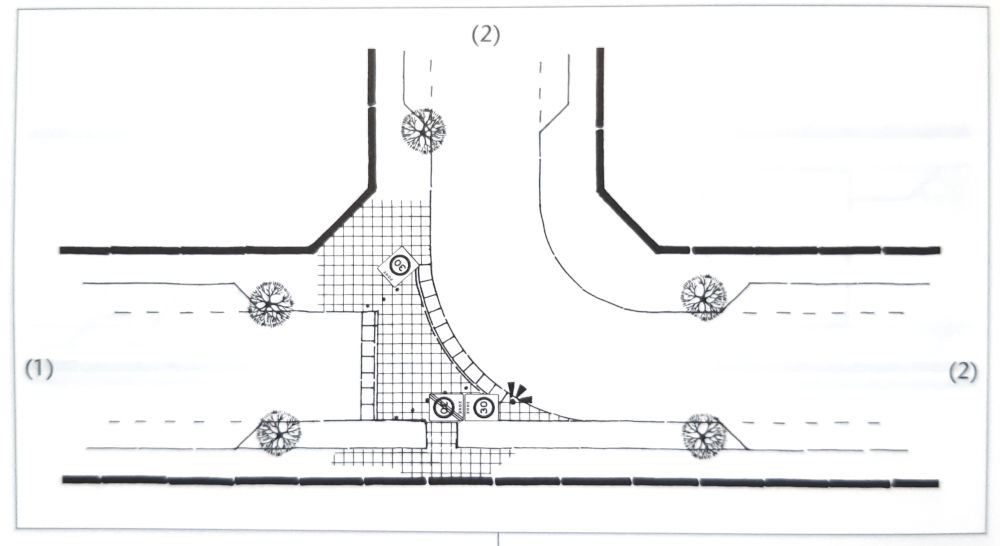
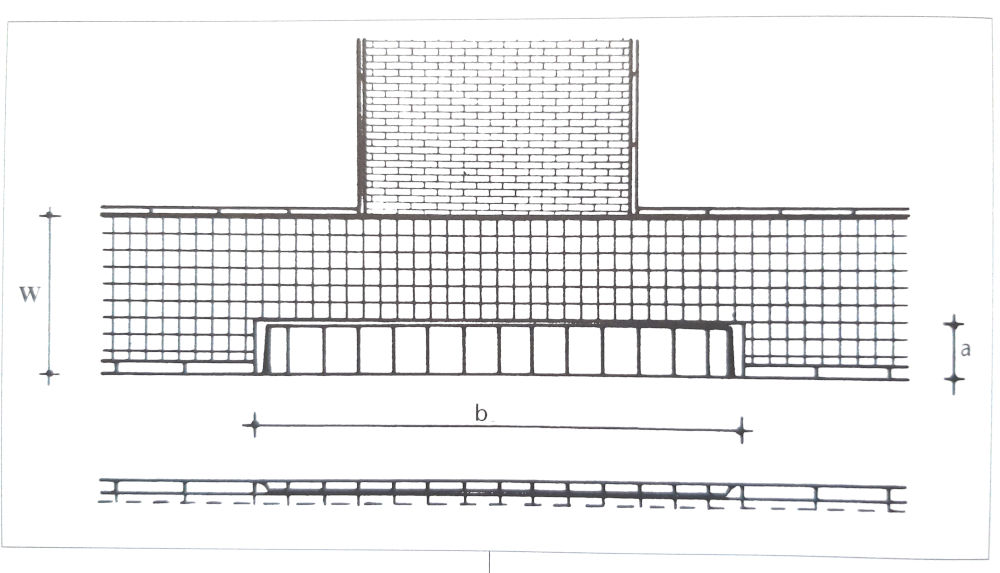
Note: larger copies of the figures shown in this section are provided in an appendix.
The term ‘continuous footway’ is missing entirely in many key national documents, and there is no description of similar infrastructure within them. This is true of the ‘Department for Transport’s Traffic Signs Manual’ [1], the legislation ‘Traffic Signs Regulations and General Directions 2016’ (TSRGD) [2], the Scottish Government ‘Designing Streets’ policy statement [3], and the ‘Highway Code’ [4].
‘Local Transport Note 1/20: Cycle Infrastructure Design’, commonly known as ‘LTN 1/20’, from the Department for Transport [5] uses the term ‘continuous footway’ only once, in a table describing the option to provide “continuous footway and cycle track across [a junction’s] minor arm” (page 162).
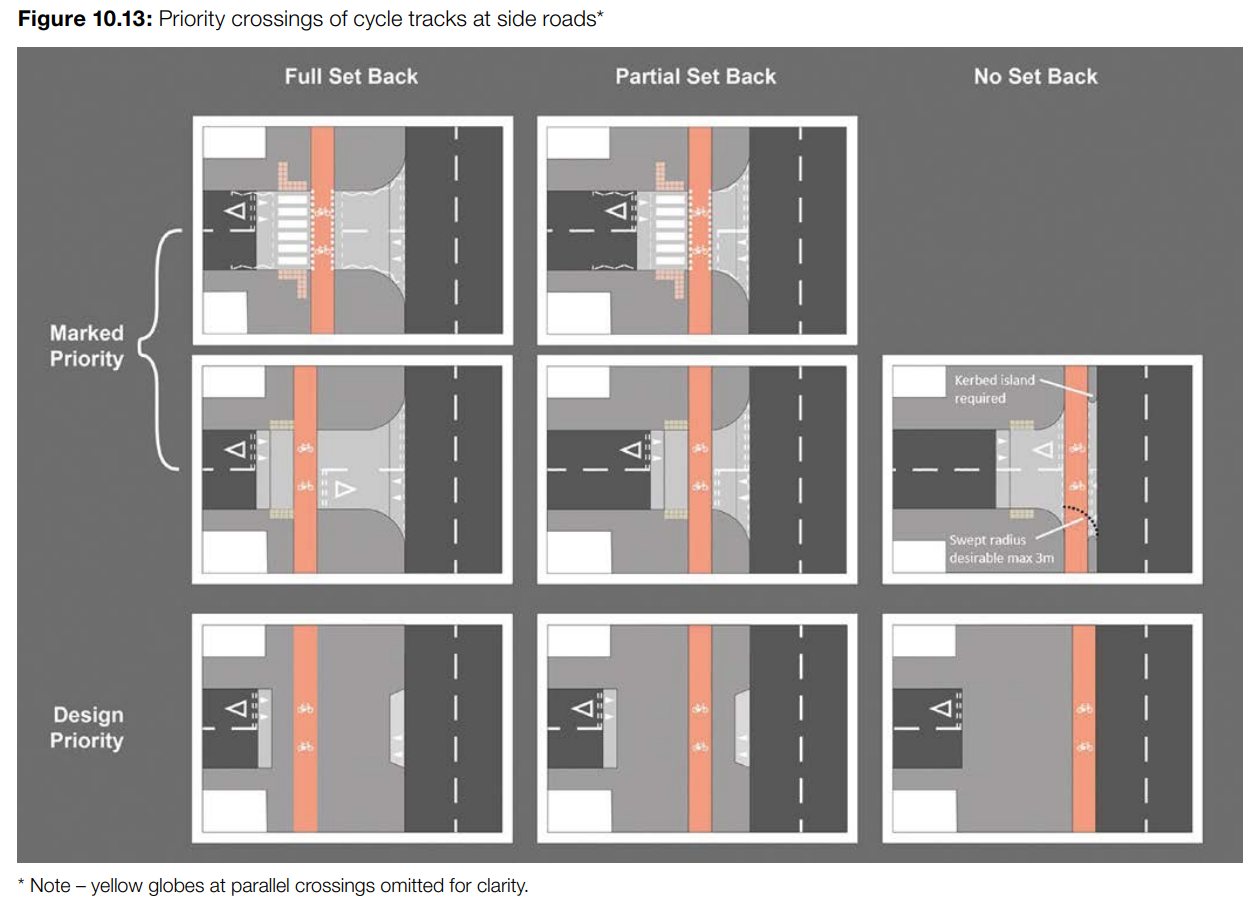
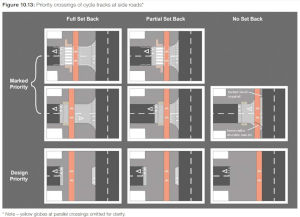
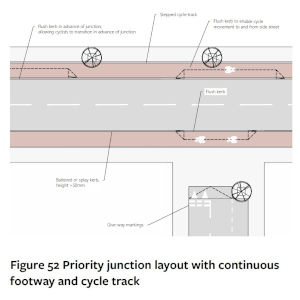
Separately LTN 1/20 includes a description of infrastructure which might be consistent with our working definition of continuous footway, but which isn’t given this title. Paragraph 10.5.11, in the section on ‘priority crossings of cycle tracks at side roads’, describes the option for a design where “effective priority is achieved through design, where changes in surfacing and minimal (if any) road markings are used to distinguish the cycle crossing from the main carriageway.”
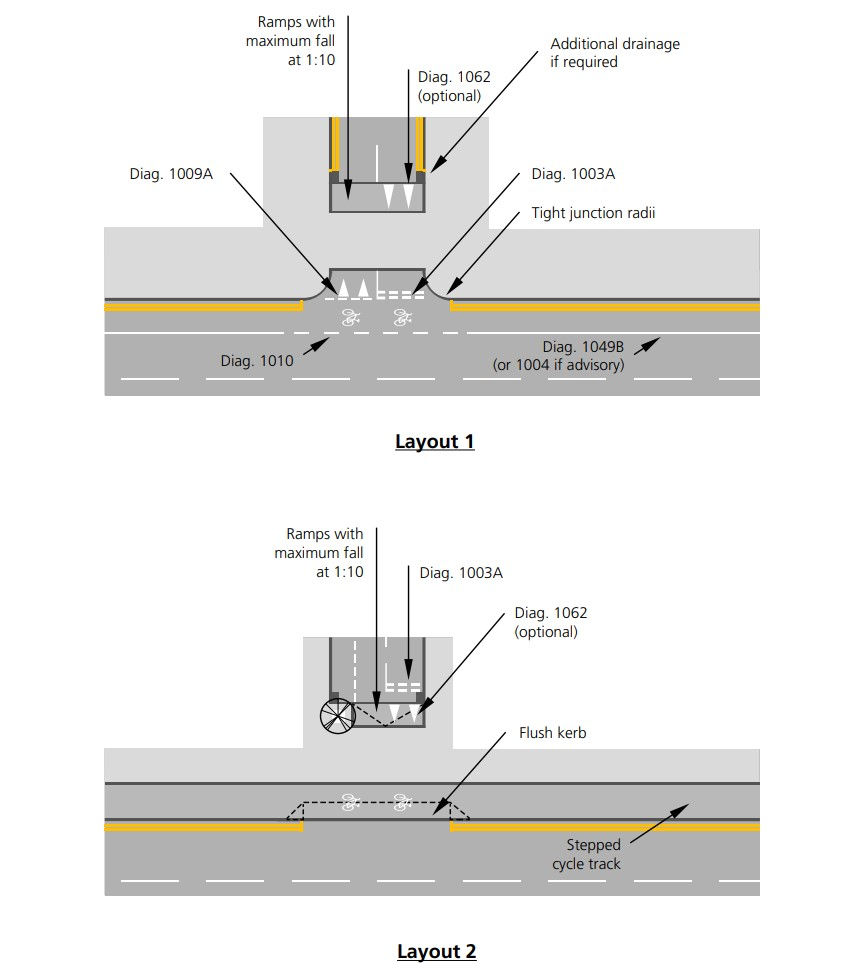
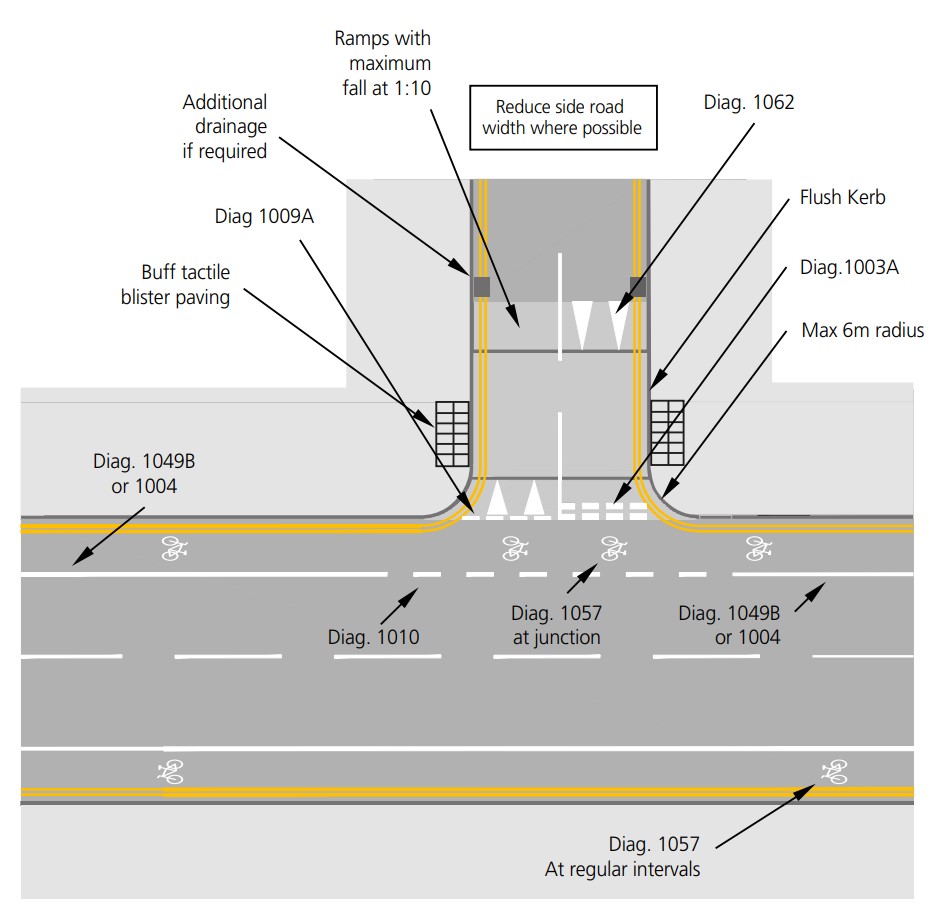
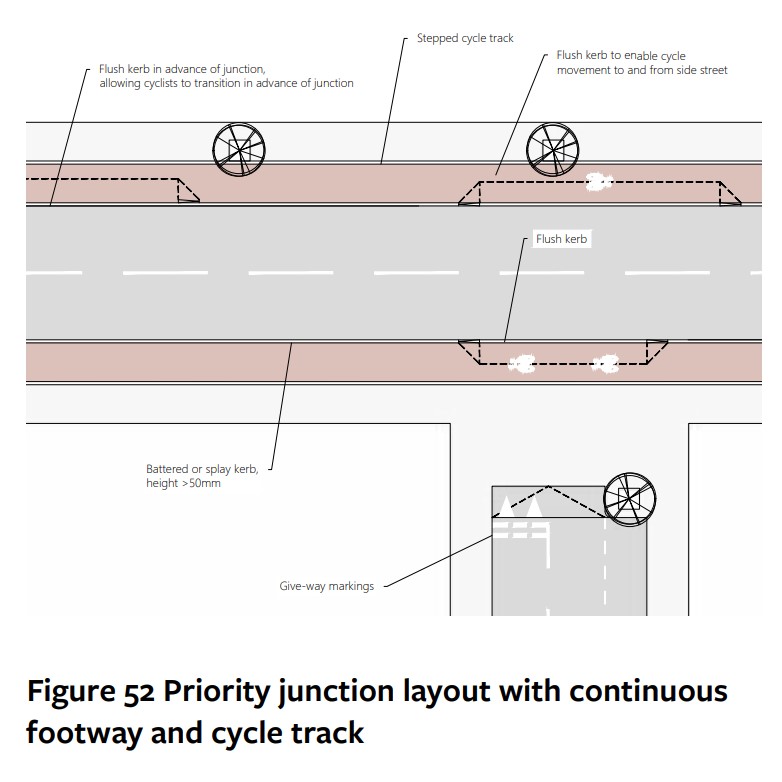
The accompanying figure (Figure 10.13) displays three options providing this ‘design priority’ where the footway of the major road continues across the end of a side road with no apparent changes to material or colour. Other options in this figure instead show options for ‘marked priority’, clearly distinguishing this from those offering ‘design priority’, and in these cases distinct changes in the footway are shown.
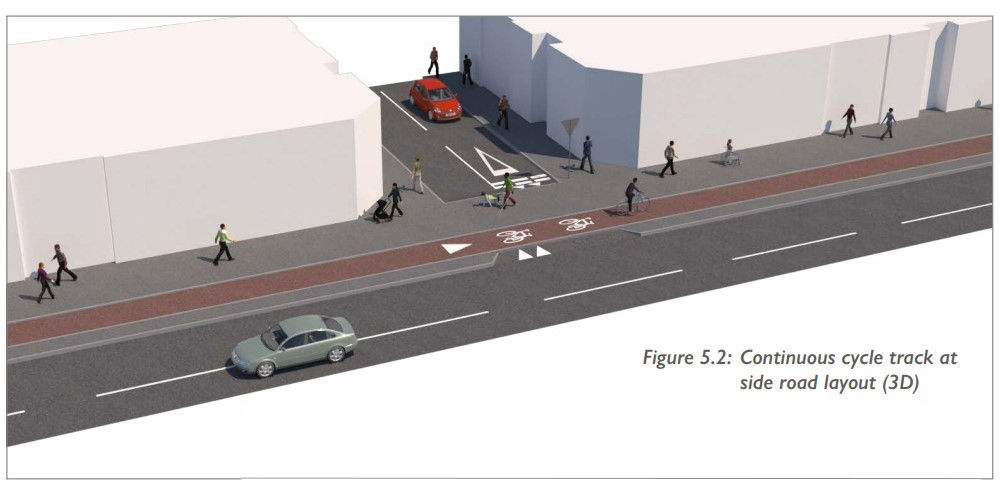
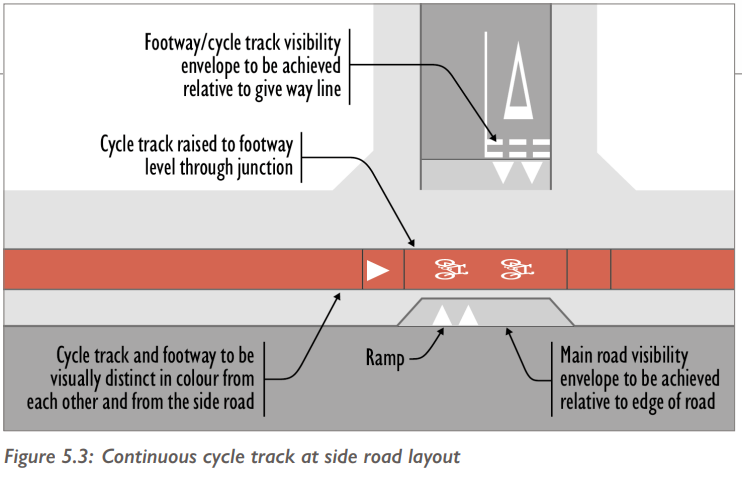
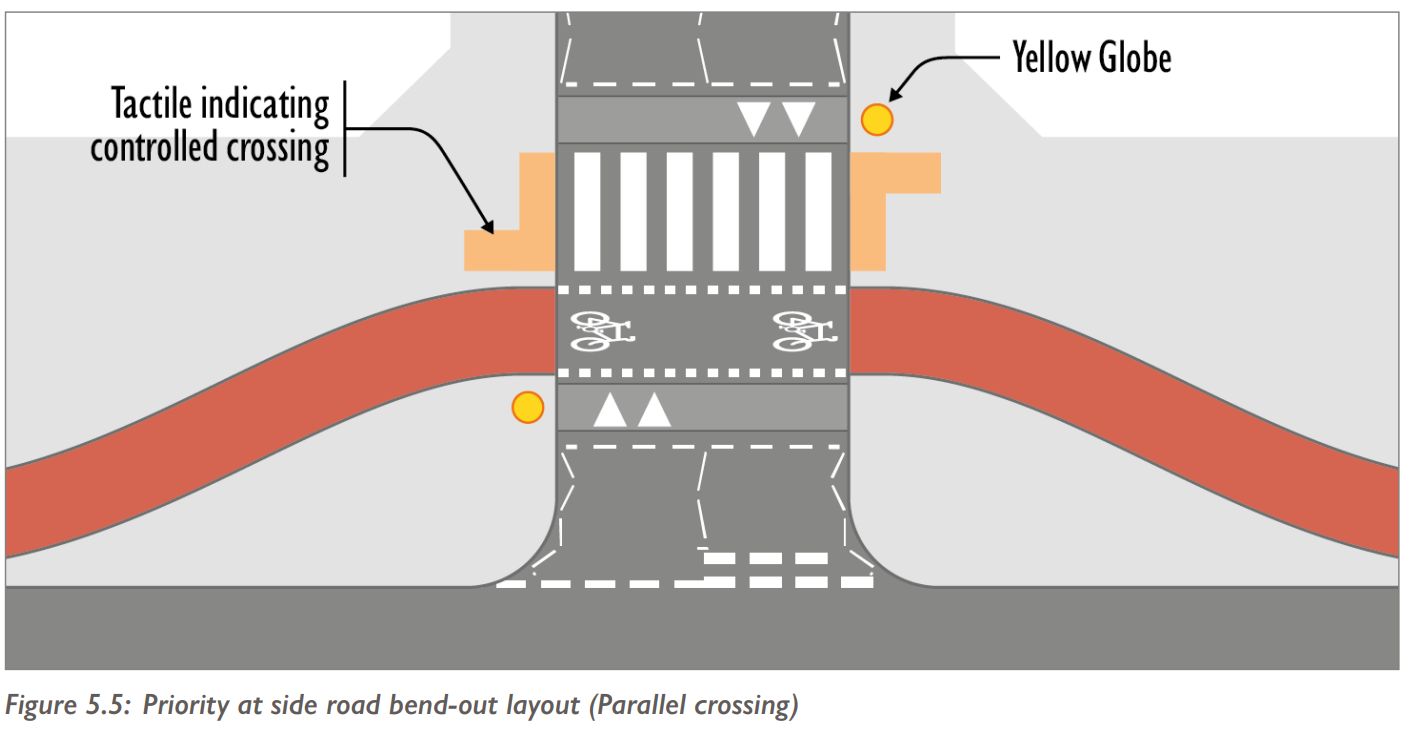
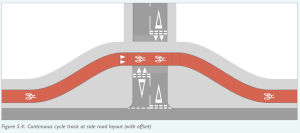
Transport Scotland’s most recent version of Cycling by Design [6] has a section specifically describing ‘continuous cycle track and footway layouts across side roads’, including images illustrating design options (Figures 5.2, 5.3, 5.4). These are described as providing “a route for cycle users and pedestrians that conveys a strong visual indication of priority over approaching and turning motor traffic.” In describing design detail this suggests:
“To be most effective, the cycle track and footway material on approach to the junction should be maintained across the side road and should visually contrast with the nearby carriageway. The layout will then provide the continuous appearance required to help convey to drivers that they are crossing a facility where they do not have priority.”
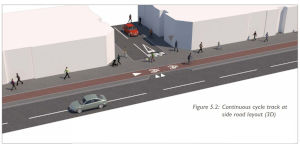
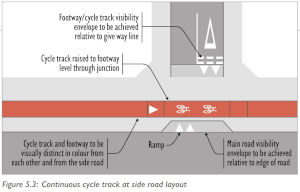
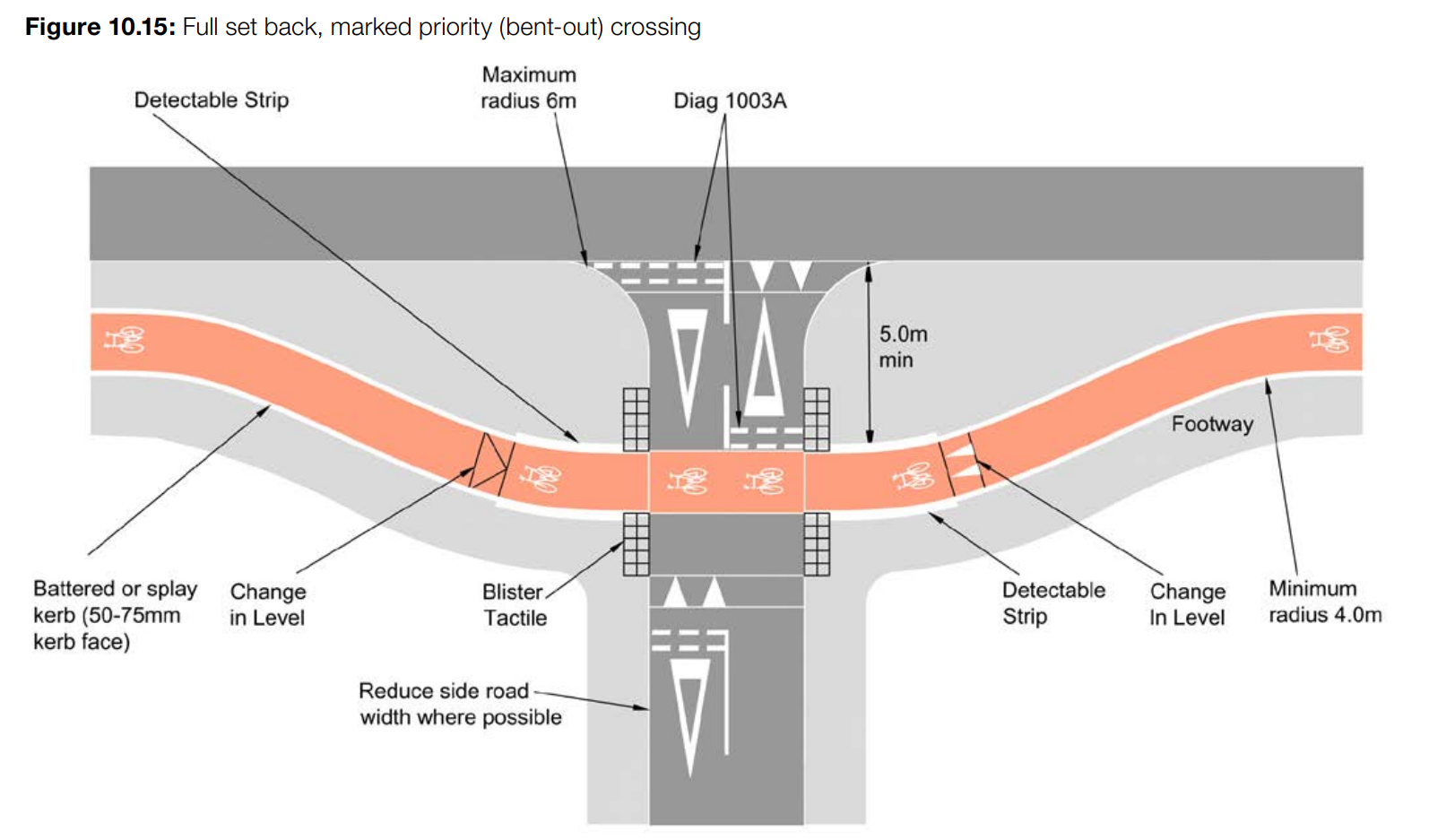
However this same section of Cycling by Design also includes a diagram (Figure 5.4, page 164), illustrating what is described as a ‘continuous cycle track at side road layout’, which closely corresponds to the illustrations in LTN 1/20 (in Figure 10.13) of situations providing ‘marked priority’ rather than ‘design priority’ – and which is almost identical to a second figure in LTN 1/20 (Figure 10.15) which is provided to illustrate a ‘marked priority’ rather than a ‘design priority’ option.
In turn, within Cycling by Design this arrangement is distinguished from a ‘priority cycle track at side road layout’ or ‘bend-out crossing’ (Figure 5.5, page 167) where priority is marked for pedestrians and cyclists using zebra markings (described in TSRGD as a parallel crossing).
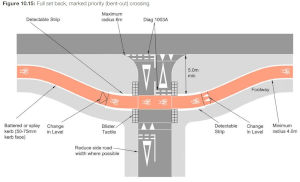
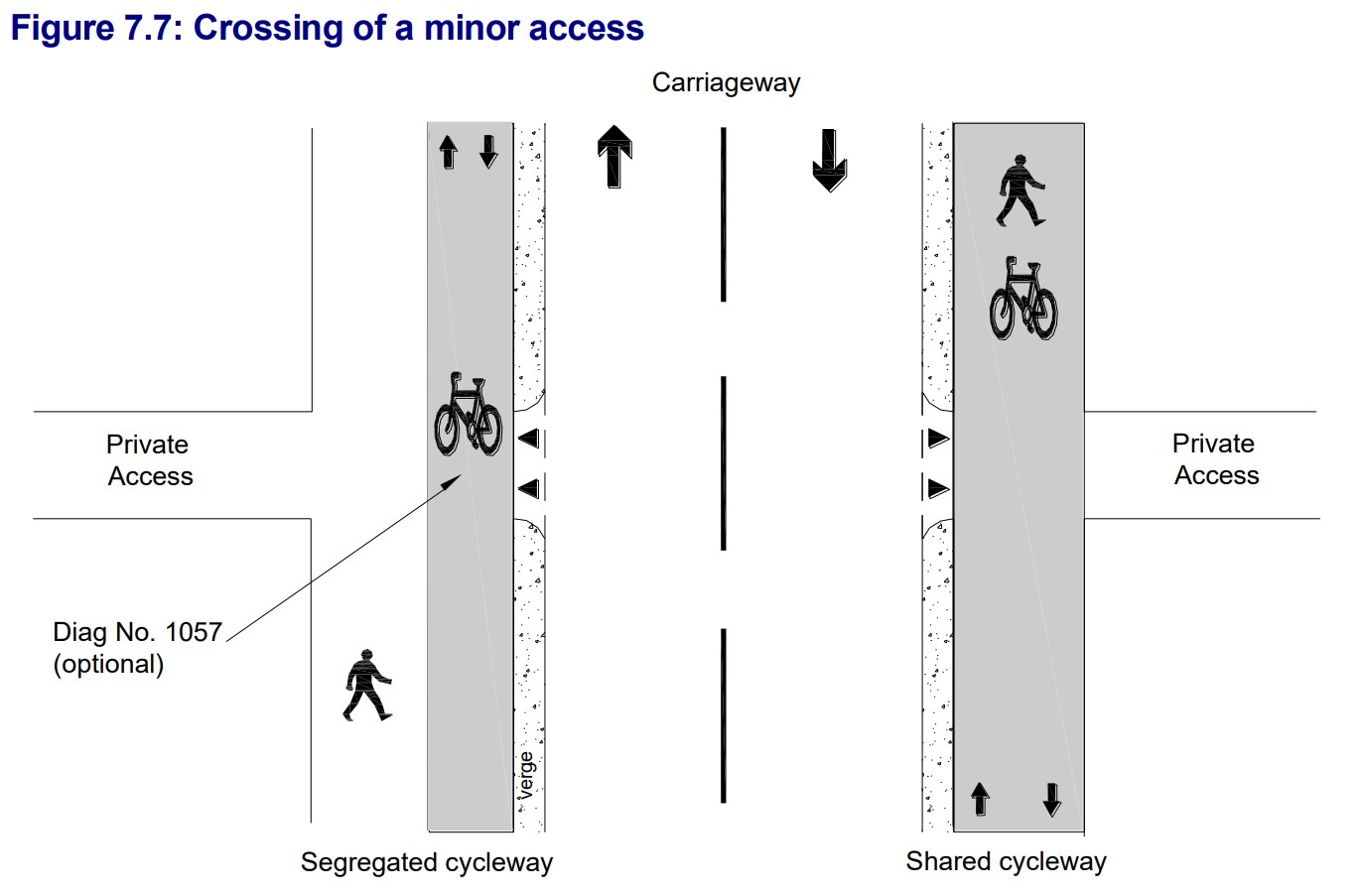
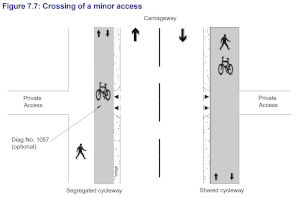
Although not using the term, an earlier version of Transport Scotland’s Cycling by Design document from 2010 [7] described an option (Section 7.2.2.2) which might be consistent with our working definition of continuous footway. This is described as a ‘crossing of a minor access’. From the accompanying image (Figure 7.7, page 87) it is clear that both the footway and an adjacent cycle track continue unbroken across what is described as “an access (either private or commercial) with low levels of vehicle movement.” The text suggests this can also to be used “where it is otherwise appropriate to give priority to pedestrians and cyclists”. It is emphasised that this layout intends to “ensure the driver clearly understands he is crossing an area where pedestrians and cyclists have priority”.
The Department for Transport’s Manual for Streets [8] does not use the term continuous footway but describes a crossing provided for vehicle access to a private driveway across a footway as a ‘vehicle crossover’. Separately (Figure 6.4, page 67) it includes a photograph of a raised side road entry treatment at what appears to be the mouth of a public street, describing this as a ‘raised crossover’.
Both the original and updated Welsh Government Active Travel Act guidance documents (2013 and 2021) [9] [10] use the phrase continuous footway as part of a description of what they title a ‘blended side road entry treatment’:
“Blended side road entry treatments involve continuing the footway across the mouth of the junction without any change to make it easier and safer for pedestrians to cross by reducing the speeds of turning vehicles, shortening the length of the crossing and providing a level route. The continuous footway strongly indicates to drivers that they should give way to pedestrians using the footway”
Accompanying design drawings are also provided
(labelled as DE605 options 1 and 2, page 406)
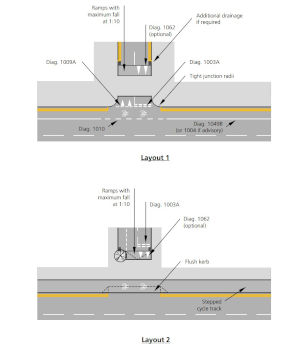
The Welsh guidance distinguishes these situations from a design of a ‘side road entry treatment’, which describes a raised side road entry treatment using a raised table (labelled as DE604, page404). However the text indicates that the raised table “may be paved in a similar material to the footway on either side.” In this circumstance it would appear that the distinction between a ‘side road entry treatment’ and a ‘blended side road entry treatment’ would consist of the inclusion, in the former case, of tactile paving and (double yellow line) road markings.

The Chartered Institute of Highways and Transportation’s ‘Designing for Walking’ [11] has two paragraphs describing a ‘blended or continuous footway junction’ which it indicates “continues the footway across a side road at the general footway levels and with the general footway materials.”
The term continuous footway is not used in many of the local guidance and standards documents we reviewed.
The Greater Manchester Interim Active Travel Design Guide [12] refers readers to the national LTN 1/20 document in regard to crossings of side roads, reproducing the text and figure (Figure 10.13) described above.

Describing an arrangement consistent with our working definition of continuous footway, the ‘West Midlands Cycle Design Guidance’ [13] comments that a “cycle track and footway should always have priority over private drives and vehicle cross-overs with fewer than 100 movements per day regardless of visibility, and it is not usually necessary to have any markings or signs.” Among a set of accompanying images (page 70) it includes one which shows a footway and adjacent cycle track continuing over a side road. It does not give this arrangement a name, although in paragraph 4.9.3 it states that priority crossings for cycle tracks at side roads can be achieved by having the “cycle track and footway continue across [the] junction [so that the] carriageway crosses them on a vehicle crossover (similar to a residential drive arrangement)”.
The Leicester Street Design Guide [14] describes ‘continuous footway’ as an intervention for side road crossings, at minor road junctions and across private accesses. However the accompanying simple diagrams include one (Figure 126, page 80) of a raised side road entry treatment which can easily be judged not to fit our working definition for continuous footway. Elsewhere the document outlines options for providing for private accesses, clearly indicating that this includes larger accesses. In this section it describes a ‘footway crossover’ as “continuous, unobstructed and adequately strengthened surface that enables vehicles (e.g. cars, light and heavy goods vehicles) to traverse the footway”.
Section 3 of the London Borough of Camden’s Streetscape Design Manual [15] doesn’t use the term continuous footway but briefly describes the use of a ‘footway crossover’ for “vehicular access to developments and residential off-street parking”. It indicates that “footway materials… should be consistent with the surrounding pavement to maintain a seamless appearance”. However it goes on to suggest a change of surface is allowable for “high traffic flows or heavy vehicles”.
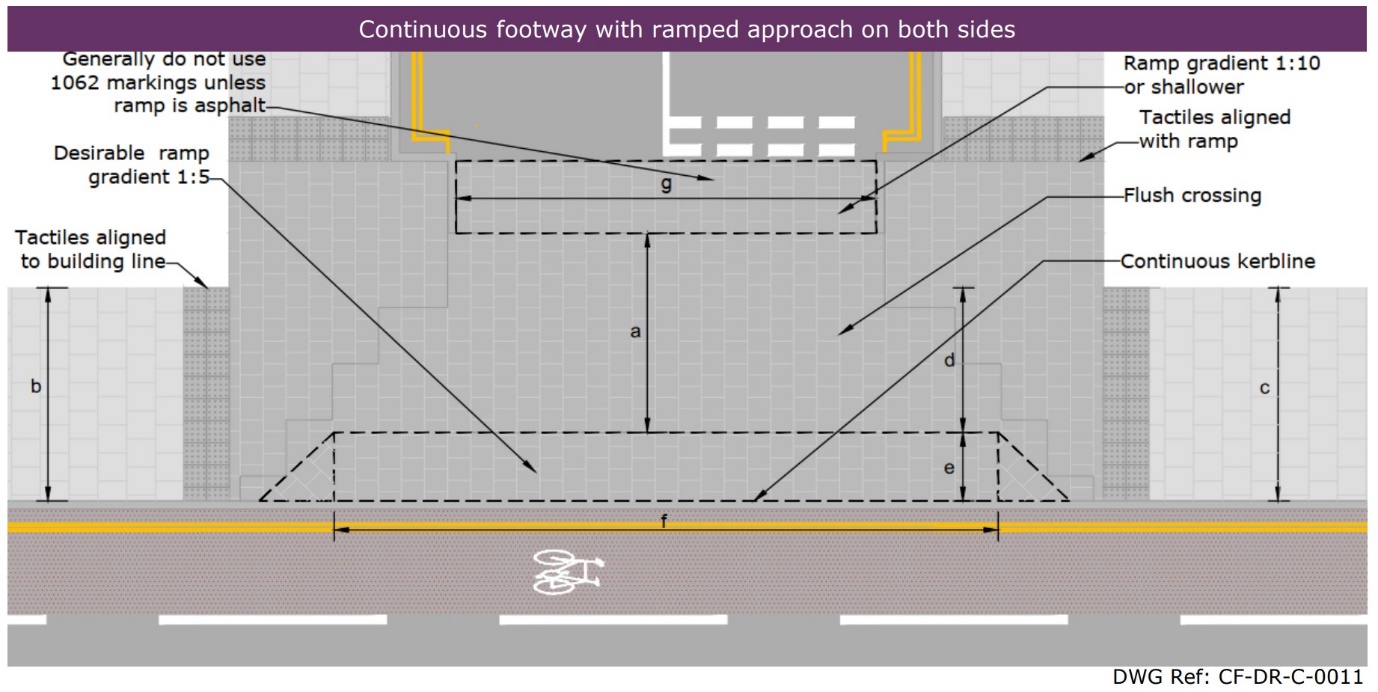
Factsheet G7 from the City of Edinburgh’s ‘Street Design Guidance’ [16] stands out from the other local guidance reviewed because it provides more extensive guidance, describing the use of ‘continuous footway’ as a specific design used at minor side street junctions. This guidance emphasises the visual continuity of the footway in the text, although the accompanying design drawings (page 9 & 10) show changes in footway colour.
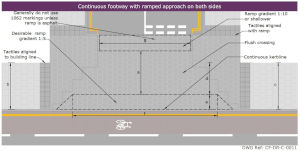

The ‘Mini-Holland Design Guide’ [17] from the London Borough of Waltham Forest describes ‘Copenhagen or blended crossings’ as “side road entry treatments that visually read as a continuation of the footway”. A photograph of a continuous footway with adjacent cycle track from Amsterdam is shown (page 40). This guide is clear in also using the title ‘blended or Copenhagen crossing’ for similar treatments at “entrances and exits to off street parking, loading and servicing.”
Within the section on ‘side road entry treatments’ Transport for London’s Streetscape Guidance [18] uses the title ‘continuous footway’, which it describes as an experimental treatment for the UK. Few details are provided (page 161). In adjacent text it describes “continuing the footway surface material across the side road entry” to create a situation where “pedestrians have priority” giving this the title ‘blended footway’. Elsewhere (page 80) it describes ‘footway crossovers’ as providing “an entry point for motor vehicles to private land”. For what it describes as ‘light crossovers’ it specifies that a “continuous footway surface” should be provided. For what it describes as ‘heavy crossovers’ it indicates that a continuous footway surface is preferred, but provides for other options.
Chapter 3 of the London Cycling Design Standards [19] includes a section (3.5.3) on ‘continuous footways and cycleways’ where “there is a strong indication that [turning vehicles] should cede priority to other users.” This includes a description, backed up by photographs, of the use of this design in Copenhagen and Stockholm. It notes an option not to continue footway materials through the structure. The accompanying drawing (Indicative layout 3/06, page 43, Chapter 3) appears to illustrate a situation showing such a change in material.
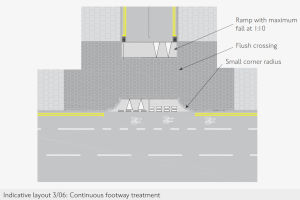
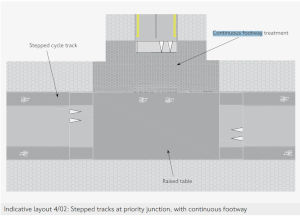
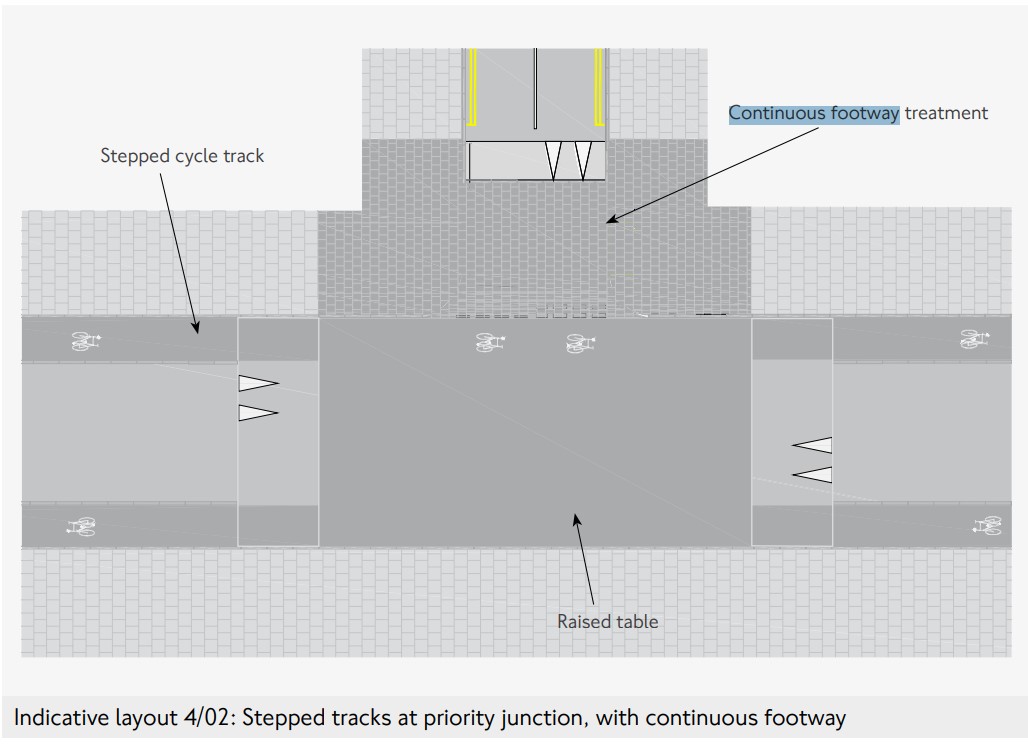
A second drawing (Indicative layout 4/02, page 21, chapter 4) illustrates an adjacent ‘stepped’ cycle track, along with a raised table on the carriageway of the larger road, suggesting reduced (if any) contrast between what is labelled as ‘continuous footway’, the cycle track, and the main carriageway.
Several more recent pieces of research published since 2017 specifically use the phrase ‘continuous footway’ as the title of a specific piece of infrastructure.
In a report ‘Driver behaviour at continuous footways research’ [20] , prepared for Transport for London, Steer Davies Gleave define continuous footway as follows:
“A continuous footway describes a junction layout where: A side road joins a major road, i.e. a priority junction, at which the footway parallel to the major road continues uninterrupted at the same grade and with the same (or visually similar) surfacing treatment (no kerb edge or tactile paving indicates a change of function).”
In research prepared for the City of Edinburgh, ‘Leith Walk cycling infrastructure analysis’ [21], referring to work in 2017 and 2018, AECOM define continuous footway as:
“an uninterrupted pavement that extends across a side road.”
This same document distinguishes continuous footway from a ‘cycle priority crossing’ where a cycle track is “continued across and given priority over [a] side road” noting that in this case “the crossing is generally sited on a flat topped road hump to ensure low vehicle speeds and provides pedestrians with a crossing point” and that “road markings are used to instruct vehicles to give way to the cycle track and pavement on approach.”
In research for Sustrans Scotland by the Centre for Transport and Society at the University of the West of England, “Evaluating the effectiveness of continuous side road crossings”, [22] Flower, Ricci and Parkin refer repeatedly to ‘continuous footways’, defining the term by explaining:
“Continuous footways are called variously: access ramp, Copenhagen crossing, blended crossing, continuous pavement, or footway crossovers. A continuous footway, which may also have a continuous cycleway lying adjacent to it, is a way of using design to establish continuous priority for pedestrians and cyclists across a side road.”
An unpublished, undated, informal report from Transport for London, uses the term, describing the monitoring of “continuous footway in the form of Copenhagen crossings” in Hoe Street in the London Borough of Waltham Forest [23]. However, it also states that “Copenhagen crossings differ from continuous footways delivered by others in use of materials and consistency of provision on a corridor – ie. the material used across the mouth of the junction generally does not match the surrounding footway.” Separately it describes the two junctions as having a ‘raised entry treatment’.
While there is little reference to foreign infrastructure in the above documents, a cursory investigation establishes that designs likely to fit our working definition are common across much or all of the Netherlands. Many more informal pieces of literature [24] [25] [26] [27] [28] [29] point to the idea that Dutch arrangements may have inspired the introduction of continuous footway in the UK.
Dutch literature appears consistent in describing these designs as exits or exit constructions (in Dutch ‘uitrit’ / ‘uitritten’ or ‘uitritconstuctie’). This is the case in research and in technical literature [30] (p196) [31](p142, p246) [32] [33] [34] [35]. This includes the formal national design guidance document ‘ASVV’, from the organisation ‘CROW’, which provides ‘Recommendations for traffic provisions in built up areas’ [36] (pp738-749). The term also appears to be used consistently in more informal literature [37] [38] [39] [40]. It is clear that these titles refer both to situations where a footway is continued over a side road and where it is continued over private entrances. These sources demonstrate that the term appears to have been relatively well defined since at least 1980 [41].
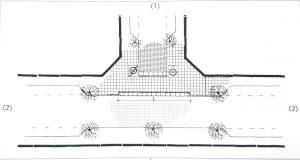
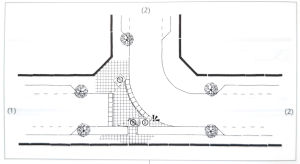
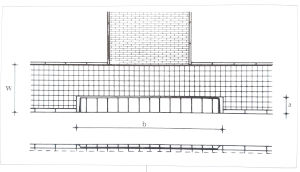
Dutch traffic rules refer specifically to the need to give way when joining a road from an exit. [42](Article 54)
As noted above, the title ‘Copenhagen crossing’ is used in some literature in the UK. Some informal literature also points to the use of continuous footways in Copenhagen [43] [44] [45]. Terminology may be less clear here. Where Dutch traffic rules refer simply to obligations when joining a carriageway from an exit Danish rules are more descriptive for example referring to the physical continuous pavement (Danish “gennemgående fortov”) at a crossover (Danish “overkørsel”).
This review provides strong evidence to confirm that within formal guidance literature in the UK:
The title ‘continuous footway’ is being used inconsistently to refer to designs which are quite different from one another.
Some designs likely to be consistent with our working definition of continuous footway are given very different titles. Titles and terminology can differ considerably between documents. Such terms include including ‘continuous footway’, ‘blended crossing’, ‘blended footway’, ‘Copenhagen crossing’, ‘raised crossover’, ‘vehicle crossover’ or ‘footway crossover’.
The word ‘crossover’ is generally associated with designs for small private entrances, but in some documents it is used to refer to situations on public streets and over much more major private entrances.
No clear distinction appears to be made in literature between designs described as continuing a footway across the end of a private access, and those continuing it across the end of a public street. Several documents directly associate the two situations.
LTN 1/20 gives introduces the title ‘design priority’. This appears to be used to refer to situations where the priority for pedestrians or cyclists is indicated clearly to drivers because the area that can be driven over, to reach a side road, appears as a section of normal footway or cycle track (establishing priority with this effect rather than with road markings). Although not using the term, several documents present a similar idea as a definitive principle, whether in descriptions of footway crossing a side road or ‘crossovers’ providing private access. Unfortunately, there is also inconsistency, with some documents which specifically describe ‘continuous footway’ indicating that road markings can be used to establish priority.
Dutch guidance on ‘exit constructions’ does not make any distinction based on the ownership of an access, but only on its size, and here the title ‘exit construction’ (uitritconstuctie) is used consistently throughout a wide variety of literature.
If inconsistencies in guidance were to be rectified it would seem that several questions would need to be addressed:
Should the title ‘continuous footway’ be used as the title of a specific design, which may or may not appear to most people to be a section of footway?
Is the term acceptable in the context of any convincing continuation of a footway across a side road or private access, however achieved in terms of materials and appearance?
If continuous footway designs are intended to create a convincing continuation of the footway, recognisable as footway to most observers, how can it be judged whether such an effect has been created or will be effective?
Does design priority’ rely on recognition and familiarity? Is this helped or hindered by the multiple designs seeking to achieve the same effect?
If studying the functioning of continuous footway designs should researchers investigate any designs described as continuous footway, especially those creating some sense of design priority or just those providing a convincing continuation of the footway?
In Section 4 we described inconsistency in formal UK literature around the use of the term ‘continuous footway’, and the alternative names given to designs which might fit our working definition of this. Later, in Section 7, we describe how design details specified in UK guidance correspond or differ.
In this section we detail how UK literature describes the ‘design goals’ in providing continuous footways, or in other words what designers are seeking to achieve in providing them.
We compare these design goals to how Dutch literature describes the purpose of ‘exit constructions’ in the Netherlands (because these create their continuous footways).
The section summary (subsection 5.6) provides a short account of our main findings.
LTN 1/20 [5] focuses on the prioritisation of cycling. Specifically it suggests that options providing ‘design priority’ exist so that “cyclists can cross the minor arms of junctions in a safe manner without losing priority.” It explains that this creates a junction where “effective priority is achieved through design, where changers in surfacing and minimal (if any) road markings are used to distinguish the cycle crossing from the main carriageway.” There is little further explanation of how ‘design priority’ works, beyond the statement that “the mouth of the junction is redesigned to emphasise the continuity of the footway and cycle track.” In a table of options for a simple priority T-junction (page 182) the option to provide a “continuous footway and cycle track across [the] minor [junction] arm” is contrasted with the option to provide a “side road entry treatment (table across minor arm).” It is indicated that the former provides conditions “suitable for all potential and existing cyclists” with “the potential for collisions … removed, or managed to a high standard of safety for cyclists.” In comparison the latter is said to offer conditions “likely to be more acceptable to most cyclists, but [which] may still pose problems for less confident or new cyclists…”
Although introducing ‘design priority’ as a method to prioritise cycling, confusingly (in paragraph 10.5.24) LTN 1/20 also suggests that junction designs offering ‘design priority with no set back’ mean that “drivers must give way to cyclists when leaving the side road, but there is no priority for cyclists over traffic turning in.”
The Welsh Government Active Travel Act Guidance [10] focuses both on prioritising pedestrian movement, and on their safety. In the text on blended side road entry treatments indicates that continuing the footway across the mouth of the junction without any change makes it “easier and safer for pedestrians to cross by reducing the speeds of turning vehicles, shortening the length of the crossing and providing a level route” and “the continuous footway strongly indicates to drivers that they should to give way to pedestrians using the footway.” As a supplementary point it indicates that these “also provide safety benefits to cyclists, helping to prevent collisions with motor vehicles turning into and out of the side road.”
The Chartered Institute of Highways and Transportation’s ‘Designing for Walking’ [11] links ideas of priority to design and behaviour at private accesses, stating that “drivers are expected to give way to pedestrians and negotiate the crossing of the footway as they would if using an access to a private site.”
Cycling by Design [6] focuses on the prioritisation of both cycling and pedestrians, and also on safety. This indicates that “continuous cycle track and footway layouts across side roads provide a route for cycle users and pedestrians that conveys a strong visual indication of priority over approaching and turning motor traffic.” In describing details it indicates that “give way markings are also offset to infer priority to pedestrians in combination with the visual continuity of the cycle track and footway”. Use of the word ‘infer’ here suggests a recognition that there is no legal or regulatory obligation for drivers to give way. Cycling by Design goes slightly further than LTN 1/20 in indicating that “the visual continuity, ramp and the tight corner radii are intended to encourage lower speeds of approaching and turning motor traffic.”
Few of the documents we reviewed provide any significant additional information on design goals.
The Leicester Street Design Guide [14] indicates that “continuous footways help to recover priority for those who do not drive [by giving] a clear visual indication to those that drive that people walking and cycling have priority.” It states that footway crossovers exist “to emphasise the distinction between public highway and private space, and to minimise disruption to the footway.” Elsewhere it states that “legally, vehicle crossovers are spaces where pedestrians have absolute priority...”
Edinburgh’s Street Design Guidance [16] focuses on benefits to pedestrians. It indicates that “continuous footways and raised tables are the preferred option as they provide a high level of priority for pedestrians” and that they “have considerable potential to improve conditions for pedestrians.” However it adds that:
”Despite their resemblance to a point closure, continuous footways should be considered part of the public carriageway and therefore Rule 170 of the Highway Code applies: pedestrians only have priority over vehicles once they have stepped onto the crossing.”
London Cycling Design Standards [19] indicate that
“…continuing footway and cycleway treatments across the mouth of the side road [aims] to convey further necessary priority for pedestrians and cyclists. Turning vehicles will need to negotiate a change in level, and they must enter and pass through a zone that looks and feels different and where there is a strong indication they should cede priority to other users.”
The Steer Davies Gleave report [20] focuses on benefits to pedestrians stating that “The design intent [of continuous footway] is to prioritise pedestrian movement along the continuous footway [and] drivers are expected to modify their behaviour accordingly.” It asserts that “the footway… continues uninterrupted at the same grade and with the same (or visually similar) surfacing treatment (no kerb edge or tactile paving indicates a change of function)”. The report concentrates on reporting on individual elements of design which they concluded had a direct effect on behaviours in each individual location.
Flower et al. [22] state that “a continuous footway, which may also have a continuous cycleway lying adjacent to it, is a way of using design to establish continuous priority for pedestrians and cyclists across a side road”. The authors refer repeatedly to this concept, that priority for pedestrians arises from the overall effects of the design, not from legal markings or rules. They describe that in interviews with their key informants a number of individual design features were highlighted as important. One of these is that “design priority for pedestrians and cyclists should be self-evident.”
The Transport for London informal report on the monitoring of junctions in Hoe Street [23] states that “continuous footways could contribute to delivering the Healthy Streets approach by enhancing pedestrian (and in some cases cycle) priority at junctions without signal control.” It also states that “they could enhance road safety by slowing turning movements” and that the designs had been used “to support transition from 30 to 20mph [speed limits].”
The informal UK literature we reviewed also points to the use of continuous footway to prioritise the passage of pedestrians [24] [43] [44] [46] [45] or cyclists [47] or both [48] [49] across a side road. The ‘Cycling Embassy of Great Britain’ in addition describe that an additional purpose of keeping vehicle speeds low [25] [47].
More rarely, the wider purposes of Dutch exit construction designs, including the marking of a transition from one kind of area or street to another, are also discussed [49] [50] [29] [51].
Various authors describe or infer that at continuous footways priority for pedestrians arises because effective designs make it very clear that the area being driven over is part of a footway [24] [43] [44] [46] [25] [29] [51] [49].
Dutch literature contrasts with the above in providing a consistent picture of a range of design goals, few mentioned consistently in UK literature.
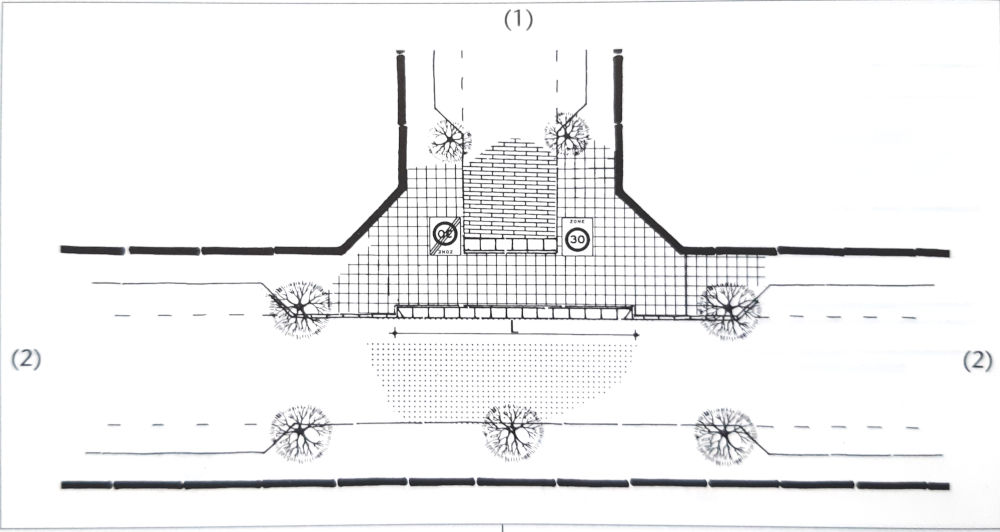
The Dutch national ASVV manual [36] on recommendations for traffic provision in built-up areas, describes an exit construction as one of several options for providing a ‘gateway’ indicating a transition between 50kph and 30kpgh areas, or providing a transition from a 50 or 30km/h zone into private property (p729).
In addition it provides a list of positive aspects of the design which are: “a very low approach speed to [the] 30-km/h-zone; clear transition to [the] 30-km/h-zone; [that the] right of way rule does not need to be indicated by a traffic sign; [and that it] may have an influence on choice of route taken [because it] deters through traffic”
In contrast to the UK guidance, there is no mention of pedestrian or cyclist priority.
The CROW ‘Design Manual for Bicycle Traffic’ [31] describes exit constructions as a method of regulating the right of way of a distributor road over a residential road (p142). It goes on to add:
“One advantage of the exit construction is that it reduces the speed of motorized traffic. This is beneficial for the right of way of cyclists following the distributor road. Furthermore, pedestrians’ right of way is regulated when driving in and out. After all, when driving into or out of an exit all road users must be given way to; in the case of priority control this only applies to motorists. An exit construction can also fulfil a gateway function and mark the entrance to a residential area starting at the side road.”
The legal and regulatory role of exit constructions is made clear in wider Dutch literature.
At exits priority is not marked [36], both by design and because such ‘exits’ include the smallest private accesses (such as to the garage of an individual private property). Article 54 of the Dutch Traffic Rules [42] mandates driving behaviour at an exit, stating (in translation) that:
“Drivers performing a special manoeuvre, such as pulling away, reversing, coming out of an exit onto the road, entering from a road into an entrance, turning around…, must give way to other traffic.”
This rule clearly distinguishes exits from other junctions where priority is not marked, which can easily be seen to be the standard design where Dutch local access streets meet.
Article 15 specifies that at such junctions [42]
“…drivers give way to drivers coming ahead of them from the right.”
Wider literature makes clear that the specific characteristics of an exit construction partly exist because of these differences in rules, ensuring that exits can be clearly distinguished from other junctions where priority is unmarked. These characteristics include:
the continuity of the footway and any cycle track without changes in material or height,
the use of special entrance kerbs and the lack of any visible curves, created by kerbs, that might suggest a road end, and
the location being one where it serves as a gateway indicating the subordinate character of the carriageway beyond the transition point.
The exception is where the status of an exit is unambiguous simply because of the presence of an obvious destination (like a private house or garage).
It is suggested that the status of these design features has arisen through case law, and because confusion can mean drivers wrongly interpreting which vehicle has priority. [38] [52] [53] [33] [34]
Is also made clear that the gateway function of an exit construction, highlighting a transition between areas of local access streets and distributor roads (with the associated speed limit change) has arisen at least partly from their ‘Sustainable Safety’ philosophy [35].
Formal UK literature appears consistent in suggesting that continuous footways are used to prioritise the movement of pedestrians, cyclists (by including a cycle track), or both across the end of a side road. It is inconsistent in that some key documents describe only a benefit to either pedestrians or cyclists, but not to both.
LTN 1/20 introduces the idea of ‘design priority’, which is described as creating “effective priority through design, where changes in surfacing and minimal (if any) road markings are used to distinguish the cycle crossing from the main carriageway”, but there is little explanation of how this design priority works. This material from LTN 1/20 is picked up in other local guidance documents, and the phrase is used in the research by Flower et al. Other documents lack any clear explanation of the mechanism by which continuous footway establishes priority.
In some informal UK literature wider purposes are described, usually consistent with Dutch literature. Dutch literature does not focus directly on the benefits of ‘exit constructions’ for either pedestrians or cyclists, but instead on the role of this infrastructure in:
physically slowing traffic,
regulating priority for motor vehicles,
providing legal priority for pedestrians,
creating a gateway effect for drivers, based on their national ‘sustainable safety’ programme, providing a recognisable and obvious transition between local access streets and those with a distributor function.
Very few studies of UK continuous footways were available, so we describe in detail all those which we reviewed.
There appears to be very little Dutch research available. We describe the most relevant we could find using a comprehensive search on the internet.
For Transport for London in 2006 TRL studied raised side road entry treatments in the city [54].
The report ‘Effects of side raised entry treatments on road safety in London’ provides a mixed picture of risks and benefits. A first stage of the study estimated the effects of entry treatments on collisions at over 1000 junctions, suggesting both positive and negative effects on collisions. In a second part of the study behaviours were observed at eight junctions with raised entry treatments, and at three control sites. They report:
“…pedestrians are more likely to obviously look for turning vehicles that may conflict with them when crossing a side road without a SRET [raised side road entry treatment] than when there is a SRET. However, it is not clear whether pedestrians expect drivers to give way at SRETs. At two sites, one control and one with a SRET, a significant minority of pedestrians appeared to assert priority and force drivers to give way to them, but overall there was no clear difference in pedestrians’ expectation of priority between SRET and control sites. Drivers showed little difference in propensity to give way to pedestrians wishing to cross the side road at control and SRET sites. … The proportion of conflicts was low at all sites, but there was a significantly greater proportion of encounters and conflicts between vehicles turning into the side road at sites with a SRET than at control sites. The difference was most marked for vehicles turning right into the side road.”
The 2018 Steer Davies Gleave study “Driver behaviour at continuous footways research” [20] was of seven junctions in London at which they considered that continuous footway existed, classifying interactions based on video footage. They offer no analysis of whether the junctions chosen met some minimum standard, whether they have been proven to provide a convincing continuation of the footway for users, or whether any of these might instead fall within our working definition of raised side road entry treatments.
Figures 4.1 and 4.2 from their study, showing aggregate figures for the seven junctions studied, are reproduced below. The study concludes that 78% of drivers slowed or stopped to give way to pedestrians already on the continuous footways, and 17% to those not already on it. In 22.5% of interactions pedestrians had to alter their behaviour to accommodate the driver. In 0.4% of interactions pedestrians had to make sudden changes of behaviour.
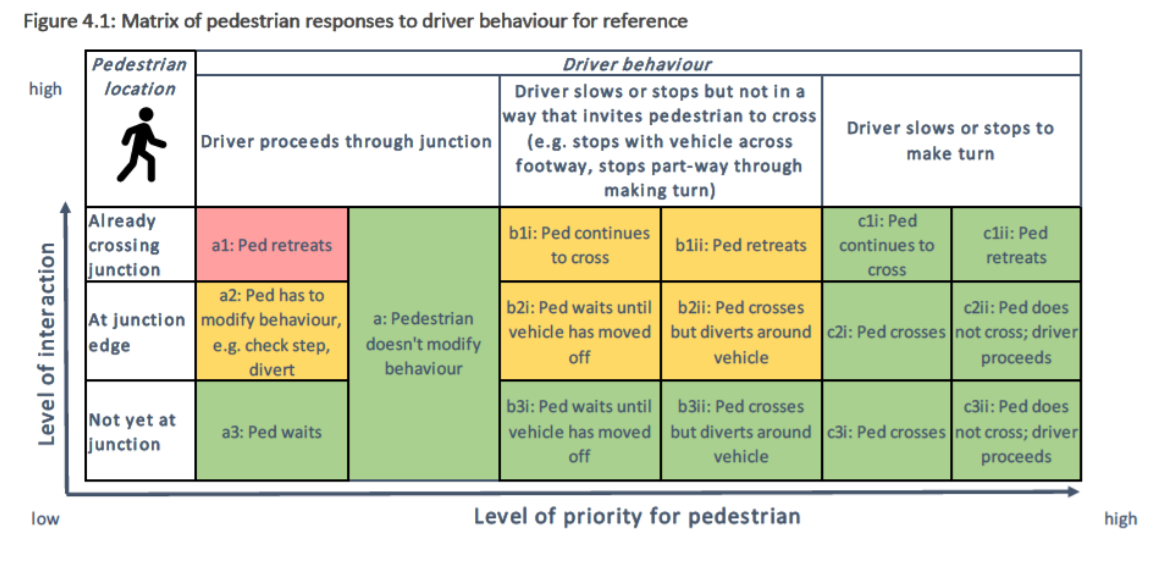
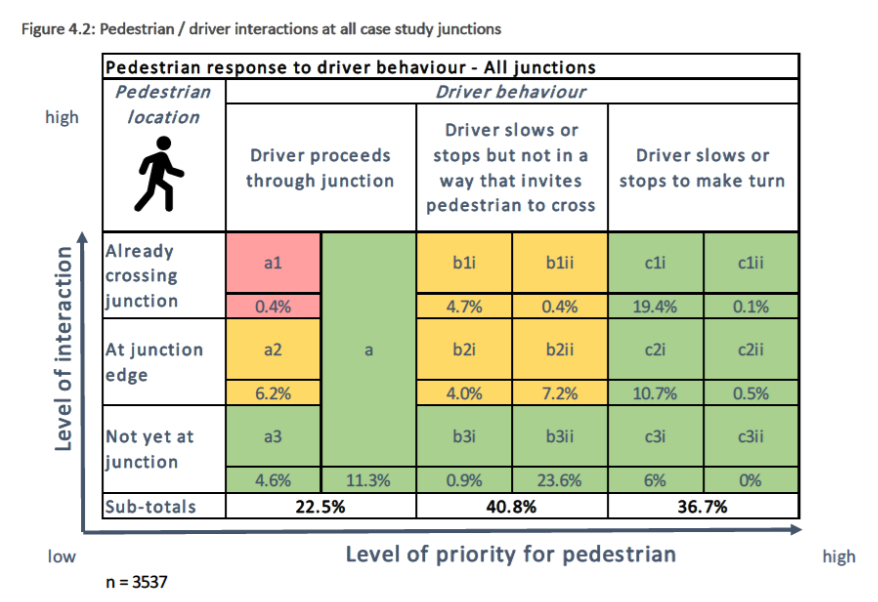
They found that continuous footways with a higher proportion of pedestrians to vehicles tended to see more drivers slowing or giving way (both to pedestrians already crossing and those approaching). Drivers were more likely to give way when turning out of the side road, and least likely when turning right into it (across an oncoming lane).
They suggest that tight corner radii, restricted sight lines, ramps, and vertical features constraining routes driven, all encouraged helpful behaviours, but that at the widest footways (i.e. with more footway to drive across) drivers exiting were less likely to slow or stop at the give way lines before progressing onto the footway (26% compared to 45.6% at narrower footways).
The 2018 AECOM [21] report “Leith Walk cycling infrastructure analysis, summary of key findings” describes work studying a single junction in Edinburgh, which they describe as a continuous footway, using video footage. There is no analysis of whether this junction met any minimum standard meaning it could be classified as continuous footway rather than a raised side road entry treatment.
The construction only allowed entering traffic and conveyed a cycle track over the side road without a break. AECOM report videoing the junction over a period of 6 days shortly after installation, and then again for 6 days in two following periods 6 months and then 12 months after installation.
They found that where there was an interaction on average non-motorised users gave way to drivers of vehicles 59% of the time in the first period, 69% in the second, and 73% in the third. Their conclusion is that the aims of the design “may not be being met”.
In a brief analysis of the design they suggest that some of the features of this junction might suggest to drivers of vehicles that it is a normal road and that research should study whether changing these would make a difference.
The report by TfL on the monitoring of ‘Copenhagen crossings’ in Hoe Street [23] is undated and appears to be unpublished in any public forum. Because of the scarcity of research we include details of this document here.
The report notes that the designs of the junctions studied did not continue ordinary footway materials across the area that can be driven on. This suggests some doubt as to whether these junctions would come within our working definition of continuous footway:
“Copenhagen crossings differ from continuous footways delivered by others in use of materials and consistency of provision on a corridor – ie the material used across the mouth of the junction generally does not match the surrounding footway”
The report states that video monitoring of two junctions was used, on two separate days between 7am and 7pm, before and after it was modified. One junction allowed only one-way movement on the side road, and the other two-way movement. The number of interactions between drivers and pedestrians is statistically very small, in the range of 9 – 65 per location on each occasion.
The most significant findings they report appear to be as follows:
“The treatment significantly increased the tendency for drivers to give way to pedestrians on turning. This was particularly noticeable for the turns from the major to the minor arm. At both sites, an uncomfortable left turn interaction (with many pedestrians retreating, having started to cross) is replaced with one that generally allows pedestrian priority and where no ‘retreating’ behaviour was recorded. Right turns from the major arm significantly decreased in number, and saw a slight improvement in give way behaviour from turning motorists. The exception – where interactions increased and drivers asserted priority more often – was the right turn out of Aubrey Road onto Hoe Street. There may be other, site-specific issues at play here.”
Although numbers are very small, the data indicates that more than 30% of drivers (where there was an interaction with a pedestrian) continued to assume priority at the junctions after they were modified.
Flower, Ricci, and Parkin carried out their study “Evaluating the effectiveness of continuous side road crossings” [22] using video footage from ten junctions they describe as continuous footway from across both England and Scotland. The locations chosen included the Edinburgh junction studied by AECOM, and two of the London junctions studied by Steer Davies Gleave. No analysis is presented to indicate whether the designs met any minimum standard allowing them to be classified as continuous footway rather than side road entry treatments. Most of the junctions had cycle tracks adjacent to the footway.
The study found that, across the whole set of study sites, 8.7% of pedestrians interacting with vehicles were “forced to yield” with additional others (1.6%) yielding voluntarily. However observations at different sites varied considerably.
Table 1 (below) is a reproduction from the report. It can be seen that forced yields varied from none to 37%. The study concluded that differences between junctions might be creating this different behaviour, and they discuss a number of features unique to each of the more problematic junctions. In a further numerical analysis they conclude that “a high proportion of the variability in the number of forced yields is explained by the flows turning right in, left in and right out” (identifying that the fourth option, a left turn out, means that a driver “will need to focus on just the nearside main road flow, and the people crossing the continuous footway”).
| Site | No yield (by person crossing road) |
Voluntary yield (by person crossing road) |
Forced yield (by person crossing) |
Percentage of no yield and voluntary yield | Percentage forced yield | Total |
|---|---|---|---|---|---|---|
| Leeds | 28 | 1 | 0 | 100.0% | 0.0% | 29 |
| London, Oval | 1018 | 2 | 5 | 99.5% | 0.5% | 1025 |
| London,Kingston | 1254 | 4 | 14 | 98.9% | 1.1% | 1272 |
| London,Stratford | 194 | 2 | 10 | 95.1% | 4.9% | 206 |
| Nottingham | 28 | 1 | 1 | 96.7% | 3.3% | 30 |
| Edinburgh | 47 | 7 | 32 | 62.8% | 37.2% | 86 |
| Southampton | 213 | 35 | 132 | 65.3% | 34.7% | 380 |
| London, Leyton | 64 | 6 | 33 | 68.0% | 32.0% | 103 |
| Walthamstow | 1119 | 9 | 133 | 89.5% | 10.5% | 1261 |
| London,Clapham | 144 | 8 | 39 | 79.6% | 20.4% | 191 |
| Total | 4109 | 75 | 399 | 4583 | ||
| Percentage | 89.7% | 1.6% | 8.7% | 100.00% |
While noting a lack of statistical evidence on whether a flow threshold exists above which it would be inappropriate to use a continuous footway, they conclude from their observational study that:
a. With very low turn flow (<20 an hour) and crossing flows less than 200 (and possibly up to 400), the continuous footways at [Leeds, Nottingham, and possibly Stratford] functioned well for both turns in and out, with very low levels of interactions and forced yields.
b. With crossing flows elevated to a level so that turning vehicles interact with more than one crossing pedestrian and/or cyclist, the continuous footways at [Oval, Kingston and Walthamstow] functioned well for turns out, both left and right.
c. With numbers of turning vehicles elevated to a level that crossing pedestrians interact with more than one turning vehicle, the continuous footway at Southampton functioned less well.
They note that looking at the total interactions, from the perspective of the driver, in 91.3% of interactions priority was offered and that this presents a more favourable picture than was recorded in the Steer Davies Gleave study.
This study also included focus groups with road users and key informant interviews with designers. Their analysis presents a list of design features which were not all present at any site, and which they suggest might be used to investigate whether it is possible to create a situation where the number of pedestrians forced to yield is negligibly small (these features are listed in Section 7 of our report).
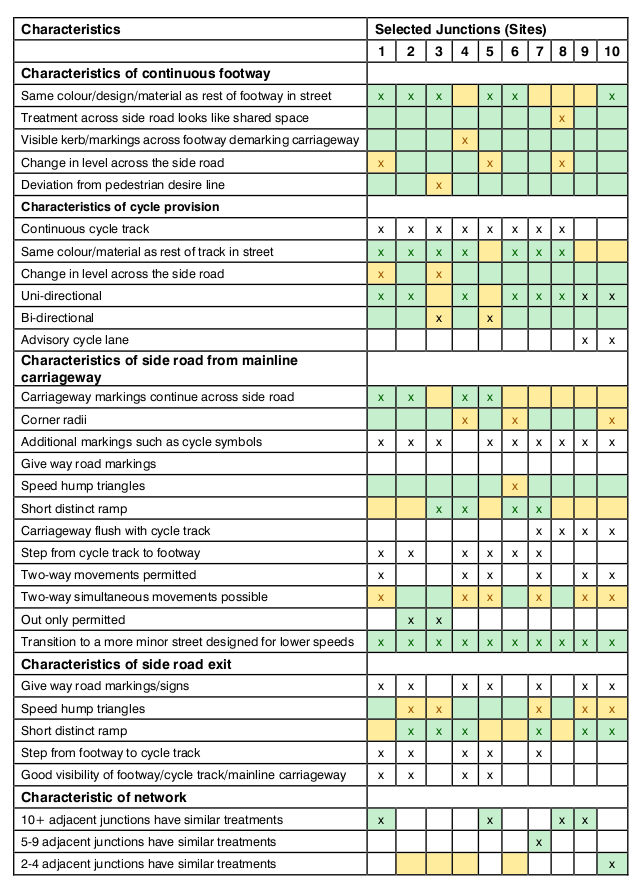
The sites studied were analysed against a set of five domains informed by a proposed standard suggested in an informal article by Robert Weetman [51], and which match many of the design features identified as important in their key informant interviews. Table 2 below is a reproduction from the report, but with additional colour coding. Green table cells indicate a feature which meets the suggested standard, and orange cells indicate a failure to do so.
As all the sites failed to meet the standards suggested (on the basis of at least two features, and most on the basis of many more) this appears to support assertions made in the study conclusions that “more examples of good practice continuous footways should be constructed to enable further study of the which design factors and flow patterns work best.”
Their key informant interviews also led to a list of ‘design challenges’ and ‘legal and regulation challenges’. These include:
a lack of national and local guidance,
a concern that there may be an obligation to provide tactile paving, but that doing so may undermine the performance of continuous footways,
that poor sight lines can be problematic,
that two-way cycle tracks mean cyclists approach from an unexpected direction,
that where a continuous footway is not wide enough (i.e. where the area driven over is less significant) drivers ignore it,
that some designs misuse road markings and that regulations around these might need to change,
the perceived need to use road markings to try to regulate behaviour more clearly, rather than omitting these, with these markings then creating the sense that the area to be driven across is part of a carriageway rather than a section of footway,
concerns about the legality of a selection of road markings, and the unavailability of markings to indicate pedestrian priority,
that there is uncertainty over the legal standing of continuous footways, and in particular whether the law would consider them part of the carriageway or footway.
Despite a careful internet search, seeking research directly but also looking for any discussion of research to be found in technical literature, we found only three reports on ‘uitritconstructie’ and ‘uitritten’ (‘exit constructions’ or ‘exits’ which create Dutch continuous footways).
Van Minnen & Catshoek [34] studied statistics about collisions and injuries on around 100 junctions, changed from having either marked priority, or unmarked priority, into exits using an ‘exit construction’. They emphasise that statistically the evidence is weak, but conclude that in the first case, where marked priority junctions were reconstructed as exits, the safety record for the junction may have been worse than before the change.
Hummel [33] built on the work by Minnen and Catshoek, investigating the locations (studied in the earlier work) where marked priority junctions had been reconstructed as exits. He presented images of these to a panel of experts and also assessed these against the national design recommendations provided by the organisation ‘CROW’.
Hummel concluded that the designs of some of these junctions differed significantly from the CROW recommendations, He found a relationship between the junctions the panel rated poorly (for how easily recognisable their status was as exits, and in terms of the safety of their design) and those identified by Minnen & Catshoek as performing poorly. Performing the same analysis as Minnen & Catshoek, but excluding these ‘poor’ junctions from the evidence, produced results indicating that the safety of junctions reconstructed as exits, which had previously had marked priority, was unchanged.
He concludes that there is little difference in safety between marked priority junctions and those using a well-designed exit construction. He argues that as safety appears comparable this alone cannot be used to justify installing an exit construction rather than a junction with marked priority (noting the higher cost of the exit construction). He comments that arguments in favour of the use of exit constructions thus need to rely on their wider roles within the Dutch Sustainable Safety programme. In this regard he refers specifically to the role of exits as indicating transition points into slow speed residential streets, and the physical restraints these place on speed.
Hummel’s assessment of design characteristics included recording:
Entrance kerbs (their presence, absence or design).
Surface materials (changes or continuity).
Road markings (presence or absence of priority marking or ramp markings).
Signage (presence or absence, particularly indicating speed limit change).
Visibility restrictions (presence or absence).
Doumen & Weijermars [35] studied how ‘sustainably safely’ Dutch roads are designed, by asking municipal road authorities (and some other road managers) what junction designs were used in which situations, and comparing this to recommendations suggested by their ‘Sustainable Safety’ policy. This demonstrates that the use of exit constructions in urban areas, at junctions between local access streets and roads with a distributor function, is very common.
Tables 3 and 4 are based on data from this research. These show the percentages of authorities indicating that they used the specific junction designs listed in the table ‘always’, ‘often’, ‘sometimes’ or ‘never’.
Table 3 indicates the situation for junctions within built-up areas between a local access street and roads with a distributor function. (Data is presented in translation, converted from the original paper to show percentages, based on answers from the 197 authorities which indicated that such junctions existed in their area.)
| Always | often | sometimes | never | |
|---|---|---|---|---|
| unmarked junction | 1% | 10% | 16% | 74% |
| priority marking/signage | 1% | 50% | 45% | 4% |
| exit construction | 1% | 58% | 26% | 14% |
| roundabout | 0% | 15% | 53% | 32% |
| traffic signals | 0% | 3% | 34% | 63% |
| other | 0% | 0% | 5% | 95% |
Table 4 (below) indicates the situation for junctions outside built up areas where a local access street meets a road with a distributor function. (Data is presented in translation, converted from the original paper to show percentages, based on answers from the 178 road managers which indicated that such junctions existed in their area.)
| always | often | sometimes | never | |
|---|---|---|---|---|
| unmarked junction | 1% | 5% | 11% | 83% |
| priority marking/signage | 10% | 61% | 24% | 6% |
| exit construction | 0% | 8% | 28% | 64% |
| roundabout | 1% | 12% | 42% | 45% |
| traffic signals | 0% | 4% | 22% | 74% |
| other | 0% | 0% | 3% | 97% |
Doumen & Weijermars did not ask about the use of exit constructions for the other four situations they studied, which were where (more major) roads which have either an area or a regional distributor function meet each other. We found no suggestion in any Dutch literature that exit constructions are ever used in these circumstances.
In Section 4 we discussed inconsistency in the use of the term ‘continuous footway’ and alternative names used for equivalent designs, and in Section 5 we discussed design goals (i.e. the purpose of continuous footways).
In this section we discuss what design features are suggested, in the literature, as contributing to the success of continuous footways in prioritising pedestrians (and cyclists). We looked at research, national and local guidance, informal literature, and formal Dutch standards.
The research by Flower et al [22] provides a substantial list of desirable design features so we have compared other UK-focused research and UK guidance to this list.
The study by Flower et al. [22] stands out because it presents a substantial list of desirable design features, derived from their key informant interviews and re-stated in their conclusions. These are:
Continuity of kerb line along main road.
No visible radii (meaning no visible curved kerb lines or equivalent suggesting a side road entrance).
Continuity of main road markings.
Vertical upstands to slow traffic (meaning ramps or an equivalent).
Continuity of materials and colours (distinguishing what is footway, cycleway and carriageway).
Continuity of level for footway and cycle track.
Good sight lines and visibility at junctions (so exiting drivers can see oncoming vehicles from the place it is intended they should wait).
Features to constrain drivers to their route (meaning physical obstacles).
A footway as wide as possible (to “give users space and time to work out how they function”).
Design priority for pedestrians and cyclists should be self-evident (as an overall factor created by the design).
They also present a list of non-design factors:
Low turning count (but the study didn’t propose a guideline).
One-way operation of side road (or other mitigating factors such as road narrowing where two-way).
Reducing traffic volume by area-wide traffic management.
Lower flows on the main road (easing movements by drivers in or out of the side road).
High numbers of crossing pedestrians and cyclists.
High ratio of non-motorised users to turning vehicles.
Using continuous footways as network transition points (from faster to slower environments).
Uni-directional cycle tracks (making bicycle movements more predictable).
Steer Davies Gleave [20] imply that many of these same factors may be important by describing such details for each of the locations studied. Their analysis also leads them to conclude that certain of these design features are important in affecting behaviours. Table 5 indicates whether Steer Davies Gleave note the status of a design feature, as listed by Flower et al., in at least one location description, and whether they conclude it to be important overall.
| Flower et al. | Steer Davies Gleave, in description |
|
|---|---|---|
| Continuity of kerb | Yes | |
| No visible radii | Yes | |
| Continuity of mainline markings | Yes | |
| Vertical upstands (ramps) | Yes | Yes |
Continuity of materials (and contrast with carriageway) |
Yes Yes |
|
| Continuity of level | Yes | |
| Good sight lines | Yes | Yes (but analysis instead suggested a calming effect of restricted visibility) |
| Constraint of vehicle route | Yes | Yes |
| Wide footway | Yes | Yes (but analysis suggested a mix of effects) |
| Overall design priority | Yes | |
| Low turning count | Yes | |
| One way side road | Yes | Yes |
| Other mitigations if two way | ||
| Area wide traffic management | ||
| Sufficiently low flow on main road | Yes | Yes |
| High pedestrian / cyclist numbers | Yes | Yes |
| High ratio of non-motorised users | Yes | |
| Use as network transition points |
Only Cycling by Design [6], and the Edinburgh Street Design Guidance [16] include more substantial design details. Table 6 (below) indicates whether these documents agree or disagree with the list of design features presented by Flower et al.
| Flower et al. | Cycling by Design (2021) | Edinburgh Street Design Guidance |
|---|---|---|
| Continuity of kerb | ?a | y (implied) |
| No visible radii | ?a | |
| Continuity of mainline markings | Y (in drawing) | |
| Vertical upstands (ramps) | y | Ye |
| Continuity of materials | Y | Y |
| Continuity of level | y (implied) | |
| Good sight lines | Yb | nd |
| Constraint of vehicle route | ||
| Wide footway | ||
| Overall design priority | ||
| Low turning count | Yc | Yd |
| One way side road | y (preferred) | |
| Other mitigations if two-way | ||
| Area wide traffic management | y (as an option) | |
| Sufficiently low flow on main road | ||
| High pedestrian/ cyclist numbers |
Yd | |
| High ratio of non-motorised users | Y | yd |
| Use as network transition points |
Notes accompanying the above table
Y indicates agreement (y indicates partial agreement or
recommendation),
N indicates disagreement (n indicates possible inconsistency or
disagreement)
a) Cycling by Design appears inconsistent in its recommendations on the continuation of the main road kerb, and on visible radii. The text states “no kerbed radius should be provided” but elsewhere talks about “tight corner radii” encouraging lower speeds. Images show ramps in carriageway colour (implying a visible corner). An option is also indicated in the text, and in an image, in which the crossing point for the footway and cycle track is offset by up to 5m from the main road, with the implication that the ‘storage space’ is designed and marked in a conventional manner for a section of carriageway (thus having visible corners).
b) Cycling by Design contrasts by implying that it is acceptable to construct a continuous footway that must be negotiated in stages, with a vehicle blocking the cycle track temporarily in doing so.
c) Cycling by Design gives a figure of 100 vehicles per peak hour on the side road as a likely threshold.
d) The Edinburgh guidance specifies continuous footway should ‘generally’ be used where pedestrian flow is greater than180 people per hour, with either average vehicle flow less than 60 per hour or peak flow less than 120 per hour.
e) The Edinburgh guidance specifies entrance ramps “as steep as possible” and gives a value of 1:5 as ‘desirable’. However it indicates that the ramp for a vehicle approaching from the side road should be “1:20 or shallower”. It allows for the omission of the ramp at the main road if the side road is exit-only.
Table 7 (below) indicates where either Cycling by Design or the Edinburgh Street Design Guidance describe additional design features or details, not specified by Flower et al.
| Cycling by Design (2021) | Edinburgh Street Design Guidance |
|---|---|
Contrast of track and footway compared to carriageway Limit of 30mph or lower on main road Maximum local width of side road Cycle track at footway level |
Limit of 30mph on main road, and 20mph on side road (preferably 20mph on main road) Visual contrast of footway with carriageway |
Other UK based guidance documents include far fewer details but individual documents agree on:
continuity of materials for the footway and any cycle track [5] [10] [18] [14],
keeping the footway at the same level [10] [19],
a maximum speed limit on the main road (40mph) [5],
this continuous footway being more appropriate in prioritising one-way cycle tracks [5], and
priority rising from the overall effect of the design indicating this to be different from an ordinary section of carriageway or a speed table [5].
However, in these documents there is also some contradictory guidance, in comparison to the points listed by Flower et al., in regard to:
continuity of materials [14],
the importance of a vertical upstand and ramp (LTN 1/20 suggests a ‘slight rise’ when driving over a stepped cycle track, although other ‘design priority’ options are drawn in a way which implies the presence of a ramp) [5],
whether footway materials must be kept the same or can be changed [10] [18],
continuity of road markings on the main road [10] [19],
whether ramps should instead be sufficiently gentle [10] or could be positioned to raise the main road rather than only the footway [19], and
on the presence of a kerb corner radius [19].
The AECOM study [21] made only one comment on design, which was that painted road markings, which curved into the side road rather than being continuous alongside the main road, might have undermined the sense that the area they studied was footway rather than carriageway.
The TFL study of Hoe Street [23] comments briefly that driver behaviour at one of the two junctions was influenced by the distance between the give-way markings and the main carriageway, with pedestrians passing on the slightly raised/patterned area behind the vehicle which had been driven across their path.
While relevant research is difficult to find, other literature gives insight into a mix of opinions over what design features might lead to good outcomes when introducing continuous footway.
Weetman’s checklist [51], which is referenced in the research by Flower et al., specifies a list of features which include: a lack of ambiguity that the area to be crossed is footway, physical constraints on speed, minimal reliance on markings or signs, a sufficiently low volume of traffic on the side road, one-way movement (in alternating directions if necessary), and that it is used to mark a transition between different characters of street (with slower speeds behind the footway). Finer details which are suggested include a necessity for contrast between footway and carriageway, continuity of footway colour and texture, and continuity of road markings on the major road.
In a short description of continuous footways the ‘Cycling Embassy of Great Britain’ [25] specifies that a continuous footway should not show any breaks or changes in design that might give the visual impression of priority to motor traffic, and that it should be at the same level as the rest of the footway.
A report for Transport Scotland, the Scottish Government and the Department for Transport by WSP entitled ‘Inclusive Design in Town Centres and Busy Street Areas’ [55] describes conclusions from focus groups. Some of these contrast with other literature because, rather than seeking a situation where the status of the footway is unambiguous, participants instead suggested that there should be indications that the area that can be driven over is not footway.
In Section 6.6 we noted that Hummel [33], working with an expert panel, ascribed problems with safety observed at some exit constructions (which create a continuous footway) as being due to the use of designs which deviated from the relevant standards (provided by the national organisation CROW).
The Dutch national ASVV manual [36] and ‘Design Manual for Bicycle Traffic [30]’ (both from CROW) specify details about ‘exit constructions’ which include that:
these function as transition points between 50km/h and 30km/h zones, and at entrances to private property,
they should only be constructed in situations with fewer than 700 PCU1 per peak hour on the through road, and 200 PCU per peak hour on the side road,
they should use the same colour and material as the rest of the footway,
the transition from carriageway onto and from the exit construction is with special Dutch bevelled ‘entrance kerbs’ (‘inritbanden’) at both sides of the construction, and continuing the kerb line of the major road,
at a very minor access (e.g. to a residence or garage immediately beside the carriageway) the rear bevelled kerb can be absent, and alternative ramp arrangements are allowed to the carriageway.
A selection of more informal articles [38] [56] [53] and research in Dutch [32] [33] [34] are consistent in describing a legal position in which the legal status of an exit is determined by its unambiguous appearance as an exit. This unambiguous status establishes that those driving over the exit construction must give way to pedestrians and other vehicles. The exception is where obvious ‘destination’ features like a private garage or very short private driveway inherently make the status of the exit clear whatever the physical appearance of the structures. These texts establish that the unambiguous appearance of an exit construction relies on:
The location indicating a clear difference in the hierarchy of roads, with a subordinate road behind the exit construction.
The continuity of the footway and any cycle track, at almost the same height and in a similar material.
The use of (‘inritbanden’) entrance kerbs (a standard Dutch bevelled kerb designed for this purpose).
The absence of connecting curved kerbing implying a road end.
The absence of priority markings.
This literature review on continuous footways has been produced as an early stage in our two-year research project, ‘Inclusive Design at Bus Stops and Continuous Footways’. As part of this bigger project a second thread of work focuses on problems arising where cycle tracks are provided at bus stops. A separate associated literature review has been carried out focusing on this thread of work.
To inform the wider project, a further, third literature review was carried out, focusing on those issues of inclusion on UK streets which are common both to the work on continuous footways and that on bus stops. This is provided as an annex (at the end of this document), and key points from this are summarised in subsection 8.1 (below).
Because the need for step-free routes on our streets is well understood the review does not explore this. It is self-evident that both continuous footways and raised side road entry treatments improve physical aspects of access for those using wheeled mobility aids. The same must be true for any other pedestrian who might struggle to negotiate a kerb or a ramp. It is difficult to assess the number of people in the UK who would use streets suitably designed for wheeled mobility aids, however the ‘Family Resources Survey 2019-2020’ [57] reports that 22% of people reported a disability, with 49% of these identifying a mobility impairment. Of those above state pension age 68% of those reporting a disability reported a mobility impairment.
Very little of the guidance and research literature reviewed provides detail on how to make designs more inclusive in any other respect.
Those documents that do discuss other issues around inclusion mention potential difficulties caused for blind or partially sighted people, who need or wish to know that they are entering an area of footway over which vehicles can be driven. Some documents go on to briefly discuss (or illustrate):
the use of tactile paving in mitigating these effects, or
the risks introduced by the use of tactile paving in regard to the overall safety and functioning of continuous footway.
Our third literature review, reproduced with this document as an annex, establishes that:
Improvements in the environment for walking, and in terms of safety from traffic, are necessary for promoting more walking/wheeling, and that positive results can emerge from such improvements.
Changes in street design can increase ‘yielding’ behaviour by drivers, even where those driving are not legally required to allow pedestrians to cross a road.
Members of the public feel that a lack of consistency between design and regulations around priority at side road junctions is not acceptable.
Driver behaviour is contingent both on road layout and social expectations.
Negotiation between road users is primarily achieved through visual communication.
This document notes the wider context, relevant not only in respect of inclusion but also to the general pedestrian experience, in which
“Designing roads for the primary purpose of accommodating vehicle journeys not only discourages walking and cycling because of the traffic – it also encourages wider driver behaviour contrary to the advice given in the Highway Code. For example Rule 170 states that drivers should “…watch out for pedestrians crossing a road into which you are turning. If they have started to cross they have priority…” However, wide splays at side road junctions enable drivers to turn or exit without having to slow down significantly or stop. Participants in a study designed to understand attitudes to priorities at side road junctions agreed that a lack of consistency between design and regulations… was not acceptable.”
It also highlights research confirming that:
“…road user behaviour is contingent both on the road layout and on social expectations. Social expectations are not fixed and, therefore, could be influenced alongside the design and introduction of new infrastructure such as continuous footway…”
It is clear that the wider context is relevant not only in respect of basic safety questions, but also the quality of experience of pedestrians:
“Being lost in thought or daydreaming can be part of the pleasure of walking, so that a pedestrian may hardly notice their surroundings at all. In contrast, having to pay attention (e.g. when interacting with people cycling or driving) can threaten and interrupt the inner life of the pedestrian, reducing some of the quality of the walking experience. So, improving the quality of the walking experience is just as important as improving the quality of the walking environment to encourage people to walk/wheel more. The same logic applies equally to cycling (or driving).“
More specifically, in relation to those who are blind or partially sighted, it concludes:
“Visual communication through movement and looking (or not looking) is the primary means of negotiating priority when pedestrians, cyclists and drivers are brought into contact with one another. This brings a unique set of challenges for blind and partially sighted people.”
This suggests an important question in relation to the use of continuous footways by pedestrians. Do designers expect that pedestrians will directly negotiate passage with drivers through an exchange of looks, or do they expect the infrastructure to communicate pedestrian priority powerfully enough so that appropriate driver behaviour is dictated without such a process?
Flower et al. [22] note that many of their key informants had concerns about whether the use of tactile paving “would undermine the effective performance of continuous footways” but that “they felt under some obligation to consider them.”
Broader research literature makes clear that tactile paving can make walking physically difficult or more worrying for some, suggesting that it may increase the risk that some people fall (although without quantifying this effect). [58] [59]
Cycling by Design [6] does not specify whether or how tactile paving should be used at continuous footway, instead reporting:
“Designers should consider the need for tactile or other information to convey a warning to blind or partially sighted pedestrians that, in the absence of an upstand, they are entering a space also used by motor vehicles. This should be managed through early engagement with relevant interested parties and is an important step towards meeting the Overseeing Organisation’s Public Sector Equality Duty. Alongside this, thought should be given to the intended visual message of continuity of the pedestrian and cycle facilities, indicating priority over approaching and turning motor traffic”
The drawings provided do not include tactile paving.
In details for crossings of minor accesses the previous version of Cycling by Design [7] refers to ‘Roads for All: a Good Practice Guide for Roads’ but only in regard to ramp profiles, not mentioning tactile paving.
The Welsh Active Travel Act Guidance [10] is clearer. In text about blended junctions it says:
“Blind and partially sighted people have some concerns about this layout as they cannot easily detect that they are crossing a side road. Therefore local engagement with users should take place before considering a design of this type.”
However Figure 12.5 is said to show a “semi blended footway at side road with kerb line and tactiles retained”
In design details it is stated that:
“Tactile paving is not provided as it suggests that pedestrians should give way to turning vehicles. The design relies on the fact that vehicles are crossing over a continuous footway.”
Design drawings show no tactile paving.
LTN 1/20 [5] does not mention tactile paving in relation to priority crossings of cycle tracks at a side road, however the main figure (Figure 10.13) appears to show this being present for junctions with ‘marked priority’ and to be missing for junctions with ‘design priority’.
The CIHT guide on planning for walking [11] says:
“When private accesses are being connected to an existing street, a simple dropped kerb [from footway to main carriageway] might be sufficient and which negates the need for tactile paving. It reinforces the position that drivers are crossing the footway, rather than pedestrians crossing a road. This can be taken a stage further with “blended junctions”
And specifically on blended junctions it notes:
“As most users will not be familiar with the layout, some pedestrians may feel intimidated continuing along a footway, which goes over a side road and engagement with access groups is recommended.”
Edinburgh’s Street Design Guidance [16] appears inconsistent on the use of tactile paving at continuous footways. One sentence reads:
“…the design of crossings with no kerb upstand or tactile paving, means that pedestrians, particularly children or those with visual impairments will assume priority…”
but on a separate page it is stated
“There is a presumption in favour of the use of tactile paving at continuous footway crossings…”
Drawings of designs (copies are provided in the appendix) include tactile paving, set back from the crossing point, indicated as “aligned to [the] building line” on the main road footway and “aligned with [the] ramp” on the side road footways.
The Greater Manchester Interim Active Travel Design Guide reproduces the figure from LTN 1/20, showing tactile paving to be omitted.
The text in the West Midlands Cycle Design Guidance [13] provides no details about tactile paving in relation to ‘crossovers’, but tactile paving appears to be absent in the accompanying images.
In details about ‘footway crossovers’ the Leicester Street Design Guide [14] says “The use of tactile paving is not required at footway crossovers. The footway surfacing material shall remain unchanged through the crossover”. Elsewhere in details about continuous footways it states
“Continuous footways help to recover priority for those who do not drive. However, this aim has gained criticism from some visually impaired advocate groups who feel they may be exposed to turning traffic without warning. Leicester’s approach will be to use this design with care only in the most appropriate contexts.”
Accompanying images do not appear to show the use of tactile paving.
For “raised crossings” and “‘access road’ crossovers” the Campden Streetscape Manual [15] indicates the use of “buff or dark grey tactile (whichever provides the greatest contrast to [the] surrounding paving).” It is clear that “tactile paving must be added at all crossing points and busy ‘access road’ crossovers.”
The Waltham Forest Mini Holland Guide [17] provides no details about the use of tactile paving at ‘blended or Copenhagen crossings’ but a design shown on page 50 appears to omit these.
In details about ‘blended footway’ situations, where the footway surface material is continued across the side road, Transport for London’s Streetscape Guidance [18] specifies “no kerb line delineation or tactile paving is required… as pedestrians have priority”. However in the text on continuous footway treatment it states:
“Further development and research is needed, in consultation with access groups, to determine acceptable approaches, given concerns over the lack of delineation between the footway and the area accessible to vehicles that runs over the entry treatment. Any proposals of this nature are subject to SDRG approval. Any proposal must be subject to an Equality Impact Assessment.”
Separately, in text about ‘footway crossovers’ it states that “tactile paving either side of the crossover is not required but may be recommended in some circumstances”
The London Cycling Design Standards document provides no detail about tactile paving at continuous footways (although a design drawing omits this), and has a similar message:
“Further development of the concept is needed, in consultation with access groups, to determine acceptable approaches, given concerns over the lack of delineation between the footway and the area accessible to vehicles that runs over the entry treatment. Any proposal should be subject to an Equality Impact Assessment.”
Informal literature on continuous footways generally, if commenting at all, urges the introduction of this design to increase inclusion on UK streets [43] [46] [45] [51].
While some of the formal literature suggests that groups interested in inclusion have concerns about continuous footway we found that there is relatively literature of a more formal nature detailing these concerns. In a short article by Hugh Huddy, as ‘Policy and Campaigns Manager’ for the RNIB [60] he expresses that the RNIB is “really concerned about the continuous footway design”, commenting that “continuous footways provide no detectable features to enable blind or partially sighted people to know where the footway has changed into a road and back again.”
In a report ‘Seeing Streets Differently’ [61] the RNIB discusses how changes to streets affect blind and partially-sighted pedestrians. They note that the document was informed by a travel survey completed by 302 self-selecting people. They comment on the importance of detectable kerbs which “…help people identify where the road is, keep pedestrians separate from moving vehicles, help people to find their way by following the line of the kerb, and are used by guide dogs in guiding.” They identify that the removal of detectable kerbs, at continuous footways and other designs, is problematic. They make no distinction between problems arising at continuous footways and those arising where other designs are used which remove detectable kerbs.
In ‘Making the Built Environment Inclusive’ [62], ‘Guide Dogs’ describe a ‘continuous footways’ or ‘continuous pavements’ as areas where “both vehicles and pedestrians are using the same level surface at [a] junction” and say that use of these “should be avoided.” They add that “these junctions are dangerous for people with sight loss, as [they] may not be aware the they are entering onto a crossing area.” However they then specify that where continuous footway is provided then strips of tactile paving, 800mm deep, should be provided “where the traditional kerb has been removed”. They go on to specify details which appear to suggest an assumption that kerbs will be absent between the footway and other areas of carriageway. Elsewhere in the document they emphasise the importance of colour and tonal contrast for tactile paving.
This review confirms that the main issue raised in literature, in relation to inclusion and continuous footways, is their effects on blind or partially sighted people. We have confirmed that:
different guidance documents are inconsistent in their recommendations about the use of tactile paving at continuous footways,
many documents completely fail to describe questions around tactile paving,
several documents describe problems around tactile paving but do not go on to offer solutions.
In this section we review literature on legislation and wider policy.
Subsection 9.1 discusses legislation relevant to continuous footways, including on road markings.
Subsection 9.2 highlights that the use of continuous footways is not covered in wider policy that seeks to ensure that streets are well designed for pedestrians and that they create a sense of ‘place’ rather than simply operating as transport corridors.
Subsection 9.3 highlights how the use of ‘exit constructions’ (which create Dutch continuous footways) is clearly covered by Dutch road rules, is consistent with their rules on road markings, is covered by their national design guidance, and is mandated by their national ‘Sustainable Safety’ policy.
As described in Section 6, Flower et al [22] report concerns, identified in their key informant interviews, which include:
a belief that some designs misuse road markings and that regulations on these might need to change,
the perceived need to use road markings that provide the sense that the area to be crossed is part of a carriageway,
the legality of a selection or road markings, and/or the unavailability of markings to indicate pedestrian priority,
a lack of clarity of the legal status of a continuous footway.
TSRGD legislation [2] is the origin of many of the rules for driving in Great Britain.
A cursory analysis2 of the TSRGD legislation, and the British Highway Code, suggests that many would find the situation described to be confusing, particularly if trying to establish means to establish priority for pedestrians.
Schedule 9, part 7, paragraph 3 of TSRGD specifies the meaning of the upright give way sign, an optional addition to support give way markings, which is:
“…that no vehicle is to cross the [give way line3], or if that line is not clearly visible, enter [the] major road, so as to be likely to endanger any person, or to cause the driver of another vehicle to change its speed or course in order to avoid an accident”
Schedule 9, part 7, paragraph 7 specifies a subtly different meaning of a give way line, omitting the phrase “endanger any person”:
“no vehicle may proceed past the [line] in a manner or at a time likely to endanger the driver of, or any passenger in, a vehicle on the major road or to cause the driver of such a vehicle to change its speed or course in order to avoid an accident…”
It is also indicated that the give way line can be used to mark the priority of a cycle track crossing a road:
“where the [line is] placed in advance of a length of the carriageway of the road where a cycle track crosses the road [and the line is marked along a route parallel to the track], that no vehicle may proceed past [this line], in a manner or at a time likely to endanger any cyclist proceeding along the cycle track or to cause such a cyclist to change speed or course in order to avoid an accident”
In regard to STOP signage, schedule 9, part 7, paragraph 1 specifies, in addition to the requirement to stop a vehicle before crossing the line, that:
“no vehicle must cross the … line, or if that line is not clearly visible, enter the major road … so as to be likely to endanger any person, or to cause the driver of another vehicle to change its speed or course in order to avoid an accident.”
Thus it appears that give way lines offer no legal obligation to give way to pedestrians, although if backed up by a give way sign, or if a STOP line is used, there is an obligation is not to “endanger any person” by passing over either of these.
These rules are described in the Highway Code [4] in rules 171 and 172, which provide less detail:
You MUST stop behind the line at a junction with a ‘Stop’ sign and a solid white line across the road. Wait for a safe gap in the traffic before you move off.
The approach to a junction may have a ‘Give Way’ sign or a triangle marked on the road. You MUST give way to traffic on the main road when emerging from a junction with broken white lines across the road.
A more major issue may exist if the intention of a continuous footway design, conveying pedestrians over the end of a public road, is to create either a section of footway or the implication that footway is being driven over. Rule 145 of the Highway Code specifies: “You MUST NOT drive on or over a pavement, footpath, or bridleway except to gain lawful access to property, or in the case of an emergency.” It indicates that this rule arises from Section 72 of the 1835 Highway Act [63], and Section 34 of the Road Traffic Act 1988 [64].
It is self-evident that this rule is very widely ignored in the UK, most obviously by those parking with vehicle wheels on the footway.
Rule 206 of the Highway Code, as updated on 1 February 2022, provides additional detail for those situations where it is legal to cross a footway:
“Drive carefully and slowly when…. needing to cross a pavement, cycle lane or cycle track; for example, to reach or leave a driveway or private access. Give way to pedestrians on the pavement and cyclists using a cycle lane or cycle track…
Rule 206 goes on to provide details about priority at side roads:
…[and when] … approaching pedestrians who have started to cross the road ahead of you. They have priority when crossing at a junction or side road so you should give way (see Rule H2).”
Rule 170 similarly specifies that at junctions
“…You should… give way to pedestrians crossing or waiting to cross a road into which or from which you are turning. If they have started to cross they have priority, so give way (see Rule H2)…”
Rule H2 reenforces this:
“…At a junction you should give way to pedestrians crossing or waiting to cross a road into which or from which you are turning….”
We identified two key documents which might be expected to offer wider guidance on the use of continuous footways, for example describing where it should be used or what its use achieves. These are:
Manual for Streets [8]
Designing Streets [3]
Manual for Streets, which applies to England and Wales, is “directed to all those with a part to play in the planning, design, approval or adoption of new residential streets, and modifications to existing residential streets.” This describes “a need to bring about a transformation in the quality of streets [which] requires a fundamental culture change in the way streets are designed and adopted…” although the document makes clear “the Department for Transport does not set design standards for highways – these are set by the relevant highway authority.”
Designing Streets describes itself as “the first policy document in Scotland on street design” and as marking “the Scottish Government’s commitment to move away from processes which tend to result in streets with a poor sense of place and to change the emphasis of policy requirement to raise the quality of design in urban and rural development.” It specifies that “information on principles, layout and street geometry which is not consistent with Designing Streets should be revised [and] Designing Streets should be adopted by all Scottish local authorities or should provide the basis for local and site-specific policy and guidance.”
Manual for Streets makes no comment on the use of continuous footways across public side streets and only comments on ‘crossovers’ in terms of access to private driveways and off-street parking. It specifies a few details for good design but nothing of their use outside of this situation. A single photograph showing a ‘raised crossover’ is included to illustrate a point about desire lines (p67), hinting that ‘crossovers’ can be used at a public side street, but showing a situation where it seems difficult to argue that the footway is continuous.
Designing Streets has even fewer details, simply reproducing the same photograph used in Manual for Streets to illustrate a point about desire lines.
The Dutch and Danish situations appear to be very different (from the situation in the UK) as regards traffic rules and road signage, and also in terms of policy.
Dutch traffic rules describing behaviour at exits are clear. Article 54 of their traffic rules and signs regulations [42] (in translation) says:
“Drivers performing a special manoeuvre, such as …coming out of an exit onto the road, entering from a road into an entrance … must give way to other traffic.”
Thus it seems likely that the exit construction (“uitritconstructie”) design in the Netherlands has evolved to make clear that it creates an exit (or entrance), because this defines priority rules as above. This distinguishes such a situation from a junction between carriageways where priority is not marked, where the rule is to give way to vehicles approaching from the right.
The meaning of standard Dutch “shark teeth” markings, which are analogous to UK give way markings, is established in Article 80 to mean that drivers must give way to drivers on the intersecting road. Thus, it appears that these markings do not indicate a requirement to give way to pedestrians.
This situation is confirmed in Dutch standards documents [36] [30], research literature [33] [34] and many more informal Dutch articles [37] [38] [52] [39] [40].
Danish traffic rules [65] specify an ‘unconditional obligation to give way’ when joining a road from any exit over a footway, cycle path, or verge raised above the carriageway (translation from Chapter 2, Section 26, paragraph 3) and to all pedestrians when driving over a footway into or out from the exit of property by the road (translation from Section 17, paragraph 2.)
A handbook on constructing and planning junctions in cities from the Danish Road Directorate [66], backs up this interpretation, specifying (Section 3.5.1-3.5.2) (in translation):
“Where a local road with low traffic is connected to a traffic road or another local road, the connection can be designed as a overkørsel [the appropriate English translation might be “crossover”]… Overkørsel must be raised above the carriageway of the primary road and be level with the primary road pavement, verge or any cycle path with a ramp towards the carriageway. Thus, one must not deviate from this if one wishes to avoid marking the obligation to give way…”
Dutch literature makes clear that the Dutch use of exit constructions is not seen primarily as a tool to support cycling, nor necessarily as a tool to support pedestrians, but as an integral element of infrastructure, used for interconnected purposes, playing a role in their systemic safety programme (known as ‘sustainable safety’) [53] [33] [34] [35]. This means that:
The locations where exit constructions are to be used is clearly specified in the key national documentation on urban street design. [36]
The designs to be used are tightly controlled, being described in the key national documentation on street design. [36]
The legal meanings of an exit construction in terms of vehicle and pedestrian (and cyclist) priority are clear. [42] [31] [38] [52]
These uses and meanings are not only discussed in documentation designed for technical staff, but also in literature directed at or created by the general public.
For example:
A web page from the ANWB (the ‘Royal Dutch Touring Club’) describes basic information to its members and the public about priority for vehicle users [56] and this includes information (with animations to illustrate) about basic rules such as giving way to vehicles from the right at unmarked junctions, priority at exits (picturing an exit construction at a side road), and priorities at roundabouts.
Youtube videos are provided by driving instructors/schools illustrating priorities at exit constructions [67] [68].
This review establishes, based on our ability to interpret the TSRGD legislation and the Highway Code, that UK signage and road marking options cannot be used to legally indicate priority for pedestrians, although they can convey a legal duty not to drive over a give way or stop line in such a way as to “endanger any person”.
The Highway Code specifies that pedestrians have priority on a footway, but that it is only legal to drive over a footway to access private property, which creates a challenge for designs intended to continue a footway over the entrance to a public street.
Key guidance on improving streets for pedestrians, in the form of ‘Manual for Streets’ and ‘Designing Streets’, does not mention the use of continuous footways. Cycling by Design, which is intended to describe options for infrastructure to support cycling in Scotland [6], does do so. LTN 1/20 [5], promoting the use of infrastructure to support cycling in England, describes options consistent with our working definition for continuous footway.
Dutch rules are clear, specifying an obligation to give way to others, including pedestrians, at an exit. Meanwhile, in the UK their priority markings do not convey this obligation. Danish traffic rules are clear that there is an ‘unconditional obligation to give way’ when joining a road from any exit over a footway or verge raised above the carriageway.
Dutch use of continuous footways (as ‘exit constructions’) is clearly specified as an element in their national systemic safety programme (known as ‘sustainable safety’), and that within this use has important purposes within that programme. Dutch literature says relatively little about the use of exit constructions to prioritise either pedestrian or cyclist movement at individual junctions.
We have established that there are many inconsistencies in terminology related to continuous footway designs, and contradictions over design details, between different design guidance documents.
Key national guidance on improving urban streets lacks any reference to the use of continuous footways, although key guidance on infrastructure to support cycling either describes continuous footways or a comparable option.
Design-oriented literature often separates descriptions of situations where a footway continues across a private entrance from those where it continues across a public street. This is the case even when it discusses wide private entrances and narrow public streets. There would seem to be a close relationship between these two situations, and some literature directly relates the two. Dutch design guidance for ‘exit constructions’ covers both situations, specifying design changes based on the significance of the exit. Confusion over this in the UK seems unhelpful, and we have found no explanation of why designs should differ only because of the ownership of land. The working definition for ‘continuous footway’ used for this project covers both situations.
UK literature appears consistent in indicating either that the purpose of continuous footway is to give priority to pedestrians, or to cyclists (when designed with a cycle track), or to both. It seems unhelpful that some literature describes advantages only to one group, omitting reference to the other.
Many guidance documents suggest the use of priority markings to indicate priority for pedestrians, but both the Highway Code and TSRGD legislation suggest that these markings do not indicate any such legal priority, or at least limit this to an obligation not to cross the line in such a way as to “endanger any person”.
Much of the literature describes the idea that priority arises at a continuous footway from the appearance that this is a section of footway rather than a section of carriageway. Several documents describe an effect they call ‘design priority’, distinguishing this from situations where priority is established by road markings or signage.
Our working definition of continuous footway appears to be consistent with the idea of design priority, and the continuation of footway across both public streets and private entrances. Our working definitions of ‘side road entry treatments’ or ‘raised side road entry treatments’ appear to be consistent with situations where there are similarities to a continuous footway but where a sense of design priority is absent.
The legal situation may complicate attempts to provide ‘design priority’ through continuous footway. Although widely ignored in practice, there appears to be a prohibition in Britain on driving over a footway, other than to access private property. This seems to be in conflict with designs intended to require driving over a ‘continuous footway’ which divides one public street from another.
Informal literature points to continuous footway designs being inspired by Dutch ‘exit constructions’, while a few formal guidance documents point to their use being inspired by continuous footways in Copenhagen.
It is clear that Dutch exit constructions must create an unambiguous recognisable ‘exit’ and that this conveys a clear legal obligation to give way, not only to pedestrians but also other vehicles. Dutch guidance literature presents a consistent message indicating how to create a situation where the status of the exit is unambiguous according to Dutch law.
It is clear that the use of Dutch exit constructions is driven nationally, as a key element in their national systemic safety programme (known as ‘sustainable safety’). Within this programme the primary role of exit constructions is not about local regulation of priority but the provision of a clear ‘gateway’ which marks a transition from higher speed roads (with a distributor function), to lower speed local access streets. We have found no evidence of any comparable role foreseen for continuous footways within any UK programme or policy.
It seems clear that the legal situation in both the Netherlands and Denmark has helped to shape the designs used there.
Dutch literature makes no distinction between exits from public streets or spaces and those from private accesses or areas. Instead it removes some design obligations only where the status of an exit is unambiguous for wider reasons, such as the presence of a private garage.
There is very little research on the use of continuous footways in the UK. Those we have sourced used video footage of junctions, demonstrating that a significant proportion of drivers did not give way to pedestrians, and that different designs in different locations performed differently.
This research suggests that none of the existing ‘continuous footway’ designs which have been used in the UK include all of the design features that some identify as being necessary to ensure that they work as intended. This raises questions about how to currently assess whether good continuous footways would work well, and whether their use would improve or damage inclusion on our streets, while only having access to compromised examples.
Flower et al. conclude:
“There are implications for the design of continuous footways arising from the research. Overall, designs need to aim at creating situation where the [number of interactions where the] turning vehicle driver does not give way are negligibly small. In [the] circumstance where the driver does not give way, the design should ensure that the vehicle speed has to be low and such that contact between different road users can be avoided by the driver. These conditions can be achieved by the principles of having: distinctive difference in paving material between the carriageway and the continuous footway in all lighting conditions; ensuring distinctive height difference across the whole continuous footway that is not compromised by the effects of longfall and crossfall4; clear separation of cycleways from footways; ensuring well maintained and unambiguous road markings; having radii and height difference that create low motor vehicle speeds; maximising inter-visibility between all road users.”
They go on to add:
“More examples of good practice continuous footways should be constructed to enable further study of which design factors and flow patterns work best.”
The little Dutch research which is available seems to have failed to establish an increase in safety for pedestrians crossing ‘exit constructions’ but this did establish that in the Dutch context designs according to Dutch guidance have a comparable safety record to those where priority is marked.
This literature review has been conducted as part of a project to investigate how continuous footways can be introduced in a way which increases the inclusivity of our streets.
The suggested absence of high-quality continuous footway designs in the UK clearly has consequences for the current study.
Given the suggested significance of ‘design priority’ it seems important that continuous footway designs are assessed according to whether they provide this. Unfortunately design priority is not clearly defined and its presence or absence would seem to be a subjective matter. It may be difficult, or impossible, to establish any objective means to judge its presence.
The working definition we have used for continuous footway appears consistent with the idea of design priority. This relies on the idea that “most footway users” and “most people driving” interpret the area that can be driven over as part of the footway.
Whether ‘design priority’ can arise from any other means, other than by providing a convincing stretch of footway (which does not appear to be carriageway space), is not discussed in the literature. Design priority might be seen to be the sense, conveyed by design features, that it is morally right or perhaps simply polite to give way to pedestrians even when a driver has legal priority. For example, it might be argued that if prominent footway ‘build-outs’ were created, which narrowed a carriageway to a single lane and which positioned a pedestrian (who was approaching the crossing point) in front of a driver rather than to their side, would encourage that driver to invite them to cross. On this basis it seems possible that some 'side road entry treatments’ which do not meet our working definition for ‘continuous footway’ could still provide ‘design priority’.
Therefore, when studying the quality of a feature described as providing a ‘continuous footway’ it may be important to try to establish:
whether the area to be driven over appears to all users to be a stretch of footway, and
whether design priority is provided through any other means.
We note that the context within which continuous footways are being introduced is an environment generally considered to exclude many people, and that a measure which successfully prioritises pedestrian movement would make streets more inclusive. Consequently such designs should not be assessed in isolation. Issues affecting inclusion in the wider street network are also relevant.
Suggestions that the provision of tactile paving might undermine a sense of design priority, by creating a visual effect suggesting the presence of carriageway, seem coherent, and to be consistent with various elements of guidance.
However, at the three most problematic sites which Flower et al studied (discussed in Section 6.5) they observed pedestrians or cyclists being forced to yield on 32-37% of interactions with drivers. It seems self-evident that designs which fail to establish a very high degree of priority for pedestrians, but which also fail to warn pedestrians who are blind or partially sighted that they are walking into an area where this is the case, will put these users at risk. It seems difficult to defend the use of such designs, and this defence will be particularly difficult if continuous footways are being introduced (with cycle tracks) primarily as a means to prioritise cycling.
It seems worth asking whether tactile paving can be provided in a manner which does not significantly undermine design priority (specifically by not suggesting carriageway edges to drivers), or whether design priority can be strongly enough established by other elements of design so that this effect is insignificant.
While the provision of a more subjective ‘design priority’ may be important it seems self-evident that features to physically and significantly constrain vehicle speeds, or to reduce the complexity of vehicle movement, may provide an additional layer of safety. Existing research has established that designs allowing higher speeds were problematic.
Features to physically constrain speeds or the complexity of vehicle movement may increase safety for all pedestrians in those situations where a wider sense of ‘design priority’ is not convincingly established. They may mitigate the risks created by poor behaviour by individual drivers. Where already slowed by physical features, drivers might be able to take action to avoid causing injury, and any injury caused is likely to be less significant.
Studies of continuous footways should therefore investigate not only the presence or absence of design priority, but whether designs significantly constrain speed and limit the complexity of vehicle movement.
Given the contradictory guidance it seems likely that existing UK continuous footway designs will vary considerably, and thus any study should try to determine which existing features improve the functioning of the design and which are more problematic.
This study identifies a need to improve guidance, and to remove inconsistency. It suggests that the success or failure of continuous footways in the UK cannot be fully studied until examples exist where all the factors suggested as improving their functioning are applied methodically.
We have identified key questions over what legal obligations to give way to pedestrians can be created (given current rules and legislation in the UK) and an absence of any clear national policy encouraging the use of continuous footways, other than as a means to support cycling. These issues may need attention if continuous footways are to become a standard element in UK street design.
| [1] | Department for Transport, Traffic Signs Manual, Department for Transport, (various dates). |
| [2] | UK parliament, The Traffic Signs Regulations and General Directions 2016, UK parliament legislation, 2016. |
| [3] | Scottish Government, Designing Streets, Edinburgh: Scottish Government, 2010. |
| [4] | UK Government, “The Highway Code,” March 2021. [Online]. Available: https://www.gov.uk/guidance/the-highway-code. [Accessed 7 February 2022]. |
| [5] | Department for Transport, Cycle Infrastructure Design (Local Transport Note 1/20), Norwich: TSO (The Stationery Office), 2020. |
| [6] | Transport Scotland, Cycling by Design 2021, Glasgow: Transport Scotland, 2121. |
| [7] | Transport Scotland, Cycling by Design 2010 (Revision 2, July 2020), Glasgow: Transport Scotland, 2010. |
| [8] | Department for Transport, Manual for Streets, London: Thomas Telford Publishing, 2007. |
| [9] | Welsh Government, Active Travel (Wales) Act 2013 Design Guidance (2014), Cardiff: Welsh Government, 2014. |
| [10] | Welsh Government, “Active Travel Act Guidance,” Welsh Government, 2021. |
| [11] | M. Philpotts, Designing for Walking, London: Chartered Institurion of Highways and Transportation, 2015. |
| [12] | Greater Manchester Combined Authority, Greater Manchester Interim Active Travel Design Guide, 2021. |
| [13] | Transport for the West Midlands, West Midlands Cycle Design Guidance, Birmingham, 2017. |
| [14] | Leicester City Council, Leicester Street Design Guide, 2020. |
| [15] | London Borough of Camden, Streetscape Manual, 2005. |
| [16] | City of Edinburgh Council, “Factsheet G7, Priority Junctions, Side Street Crossings, V1.1,” in Edinburgh Street Design Guidance: Part C. Detailed Design Manual, 2019. |
| [17] | London Borough of Waltham Forest, “Mini-Holland Design Guide,” (undated). [Online]. Available: https://www.enjoywalthamforest.co.uk/wp-content/uploads/2015/01/Waltham-Forest-Mini-Holland-Design-Guide.pdf. [Accessed 1 11 2021]. |
| [18] | Transport for London, Streetscape Guidance (Fourth Edition, 2019 Revision 1), 2019. |
| [19] | Transport for London, London Cycling Design Standards, 2014 (amended 2016). |
| [20] | Steer Davies Gleave, “Driver behaviour at continuous footways research,” 2018. [Online]. Available: https://www.whatdotheyknow.com/request/558800/response/1325736/attach/3/Continuous%20footways%20research%20report%20v3.0%20Redacted.pdf. [Accessed 1 11 2021]. |
| [21] | AECOM, “Leith Walk cycling infrastructure analysis. Summary of key findings.,” (undated). |
| [22] | J. Flower, M. Ricci and J. Parkin, “Evaluating the effectiveness of continuous side road crossings,” Centre for Transport and Society, University of the West of England, Bristol, 2020. |
| [23] | Transport for London, “Before and after monitoring of Continuous Footways (Copenhagen Crossings) in Hoe Street, Waltham Forest,” Transport for London, (date unclear - likely 2016). |
| [24] | "Bike Riding Motorist", “Side road treatments – do most British designs miss the point?,” 20 May 2016. [Online]. Available: http://www.happycyclist.org/?p=1326. [Accessed 15 September 2021]. |
| [25] | Cycling Embassy of Great Britain, “Continuous footway,” [Online]. Available: https://www.cycling-embassy.org.uk/dictionary/continuous-footway. [Accessed 15 September 2021]. |
| [26] | Cycling Embassy of Great Britain, “Good Cycling Facility of the Week: 14th September 2017,” 2017. [Online]. Available: https://www.cycling-embassy.org.uk/photos/good-cycling-facility-of-the-week/good-cycling-facility-of-the-week-14th-september-2017. [Accessed 15 September 2021]. |
| [27] | Cycling Embassy of Great Britain, “Good Cycling Facility of the Week: 29th June 2017,” 2017. [Online]. Available: https://www.cycling-embassy.org.uk/photos/good-cycling-facility-of-the-week/good-cycling-facility-of-the-week-29th-june-2017. [Accessed 15 September 2021]. |
| [28] | "Ranty Highwayman", “https://therantyhighwayman.blogspot.com/2013/02/we-can-rethink-little-things-to-improve.html,” 16 February 2013. [Online]. Available: https://therantyhighwayman.blogspot.com/2013/02/we-can-rethink-little-things-to-improve.html. [Accessed 15 September 2021]. |
| [29] | R. Weetman, “Design Details 1,” 13 November 2018. [Online]. Available: https://robertweetman.wordpress.com/2018/11/13/design-details-1/. [Accessed 15 September 2021]. |
| [30] | CROW, Design manual for bicycle traffic, Ede: CROW, 2007 (English edition). |
| [31] | CROW, Design manual for bicycle traffic, Ede: CROW, 2018 (English edition). |
| [32] | J. v. Minnen, “Veilige uitritconstructies in het Westland,” SWOV, Leidschendam, 1997. |
| [33] | T. Hummel, “Nader onderzoek uitritconstructies en voorrangskruisingen,” SWOV, Leidschendam, 1998. |
| [34] | J. v. Minnen and J. Catshoek, “Uniformering voorrangsregeling. Onderzoek naar de veiligheid van voorrangskruisingen en uitritconstructies .,” SWOV, Leidschendam, 1997. |
| [35] | M. Doumen and W. Weijermars, “Hoe duurzaam veilig zijn de Nederlandse wegen ingericht?,” SWOV, Leidschendam, 2009. |
| [36] | CROW, ASVV Recommendations for traffic provisions in built-up areas, Ede: CROW, 1998 (English edition). |
| [37] | Infopolitie.nl, “Uitritconstructies,” [Online]. Available: https://www.infopolitie.nl/index.php/de-schatkist/verkeer/1190-uitritconstructies. [Accessed 15 September 2012]. |
| [38] | Verkeerskunde, “Is dit een uitrit of niet?,” Verkeerskunde, 30 April 2015. [Online]. Available: https://www.verkeerskunde.nl/vraag-en-antwoord/is-dit-een-uitrit-of-niet. [Accessed 15 September 2021]. |
| [39] | I. M. Ligt, “Uitritten gedefinieerd,” Verkeersjunde, no. 12, pp. 18-19, 1992. |
| [40] | Fietsersbond ENFB, “Uitritconstructies,” in Wijken voor de fiets, Amsterdam, Fietsersbond ENFB, 1987, pp. 50-51. |
| [41] | J. H. Kraay, “De Effecten van Verkeersdrempels,” SWOV, Voorburg, 1980. |
| [42] | “Reglement verkeersregels en verkeerstekens 1990 (RVV 1990),” 1990. [Online]. Available: https://wetten.overheid.nl/BWBR0004825/2021-07-01. [Accessed 15 September 2021]. |
| [43] | L. Marstrand, “Re-think of side road junction layouts needed to ensure priority for pedestrians,” TransportXtra, 14 October 2019. [Online]. Available: https://www.transportxtra.com/publications/local-transport-today/news/62365/re-think-of-side-road-junction-layouts-needed-to-ensure-priority-for-pedestrians/. [Accessed 15 September 2021]. |
| [44] | Urban Movement, “Clapham Old Town Landscape + Urban Realm,” [Online]. Available: http://www.urbanmovement.co.uk/claphamoldtown.html. [Accessed 15 September 2021]. |
| [45] | M. Danish, “Walking priority at side roads,” Cambridge Cycling Campaign, 2018. [Online]. Available: https://www.camcycle.org.uk/magazine/newsletter137/article16/. [Accessed 15 September 2021]. |
| [46] | Road Danger Reduction Forum, “RDRF Response to CWIS Safety Review Survey 2018,” 2018. [Online]. Available: https://rdrf.org.uk/2018/05/30/1859/. [Accessed 21 September 2021]. |
| [47] | Cycling Embassy of Great Britain, “A View from the Drawing Board - Cycle Track Priority Across Side Roads,” 26 July 2013. [Online]. Available: https://www.cycling-embassy.org.uk/blog/2013/07/26/a-view-from-the-drawing-board-cycle-track-priority-across-side-roads. [Accessed 21 September 2021]. |
| [48] | "Ranty Highwayman", “We can rethink the little things to improve walking and cycling,” 16 February 2013. [Online]. Available: https://therantyhighwayman.blogspot.com/2013/02/we-can-rethink-little-things-to-improve.html. [Accessed 21 September 2021]. |
| [49] | The Alternative Department for Transport, “Continuous paths across minor junctions,” 21 August 2012. [Online]. Available: https://departmentfortransport.wordpress.com/2012/08/21/continuous-paths-across-minor-junctions/. [Accessed 21 September 2021]. |
| [50] | P. James, “Gateways,” 26 February 2012. [Online]. Available: https://pedestrianiselondon.tumblr.com/post/18314850805/gateways. [Accessed 21 September 2021]. |
| [51] | R. Weetman, “Design Details 2,” 1 October 2019. [Online]. Available: https://robertweetman.wordpress.com/2019/10/01/design-details-2/. [Accessed 21 September 2021]. |
| [52] | CROW, “De CROW-helpdesk,” Crowetcetera, p. 11, July 2012. |
| [53] | T. Hummel, J. v. Minnen and P. v. Vliet, “Welke kruising krijgt voorrang? Voorrangskruising of uitritconstructie?,” Verkeerskunde, pp. 36-38, Jaunuary 1999. |
| [54] | K. Wood, I. Summersgill, L. F. Crinson and J. A. Castle, “Effect of side raised entry treatments on road safety in London,” TRL Limited, 2006. |
| [55] | WSP, “Inclusive Design in Town Centres and Busy Street Areas,” Edinburgh, 2021. |
| [56] | ANWB, “Voorrang, wanneer wel en wanneer niet?,” ANWB, [Online]. Available: https://www.anwb.nl/verkeer/veiligheid/voorrang. [Accessed 22 September 2021]. |
| [57] | Department for Work & Pensions, “Family Resources Survey: financial year 2019 to 2020,” Department for Work & Pensions, 2021. |
| [58] | R. Newton, M. Ormerod, E. Burton, L. Mitchell and C. Ward-Thompson, “Increasing Independence for Older People through Good Street Design,” Journal of Integrated Care, 2010. |
| [59] | S. Thies, L. Kenney, D. Howard, C. Nester, M. Omerod, R. Newton, R. Baker, M. Faruk and H. MacLennan, “Biomechanics for inclusive urban design: Effects of tactile paving on older adults' gait when crossing the street,” Journal of Biomechanics, 2011. |
| [60] | H. Huddy, “When is a pavement not a pavement?,” RNIB, 4 December 2018. [Online]. Available: https://www.rnib.org.uk/when-pavement-not-pavement. [Accessed 28 September 2021]. |
| [61] | RNIB, “Seeing Streets Differently , how changes to our streets and vehicles are affecting the lives of blind and partially sighted people,” RNIB, (unspecified publication date). |
| [62] | A.-o. Helen and A. Marsh, “Making the built environment inclusive - guidance on ensuring regeneration schemes are accessible for people with sight loss,” Guide Dogs, 2021. |
| [63] | UK Parliament, HIghway Act 1835, London, 1835. |
| [64] | UK Parliament, Road Traffic Act 1988, London, 1988. |
| [65] | Danish government, “Bekendtgørelse af færdselsloven,” 2017. [Online]. Available: https://www.retsinformation.dk/eli/lta/2021/1710#id33b70439-70eb-4c95-882f-daadc3e503a0. [Accessed 15 September 2021]. |
| [66] | Vejregler (Danish Road Directorate), Håndbog vejkryds i byer anlæg og planlægning, 2018. |
| [67] | Verkeersschool Weber, “In en uitrit constructie!,” Youtube, 29 April 2018. [Online]. Available: https://www.youtube.com/watch?v=P9C-n2HgYb8. [Accessed 30 September 2021]. |
| [68] | D-K AutoRijschool, “Uitrit constructie,” Youtube, 1 March 2021. [Online]. Available: https://www.youtube.com/watch?v=Wu4Qv5Gckiw. [Accessed 30 September 2021]. |